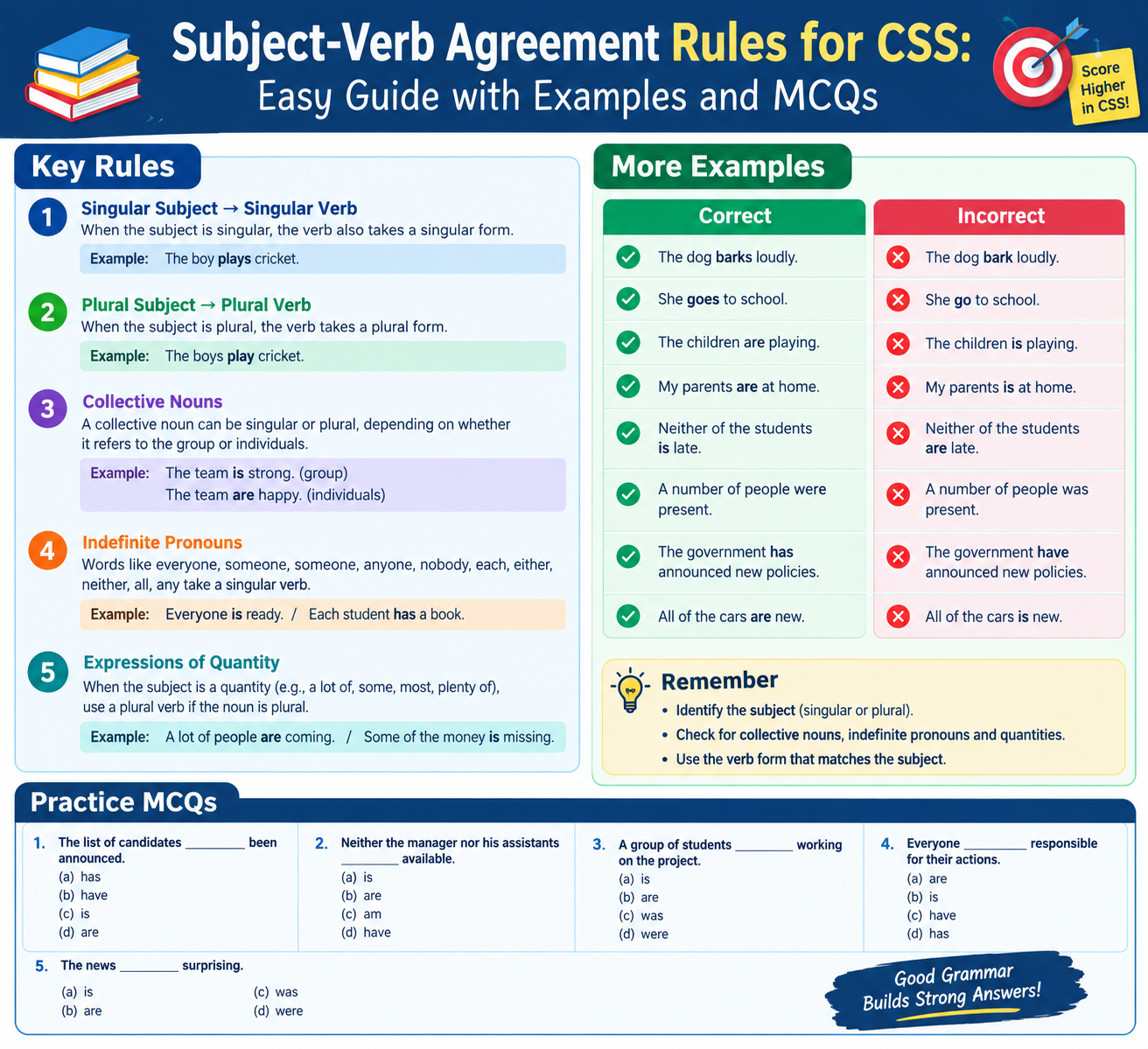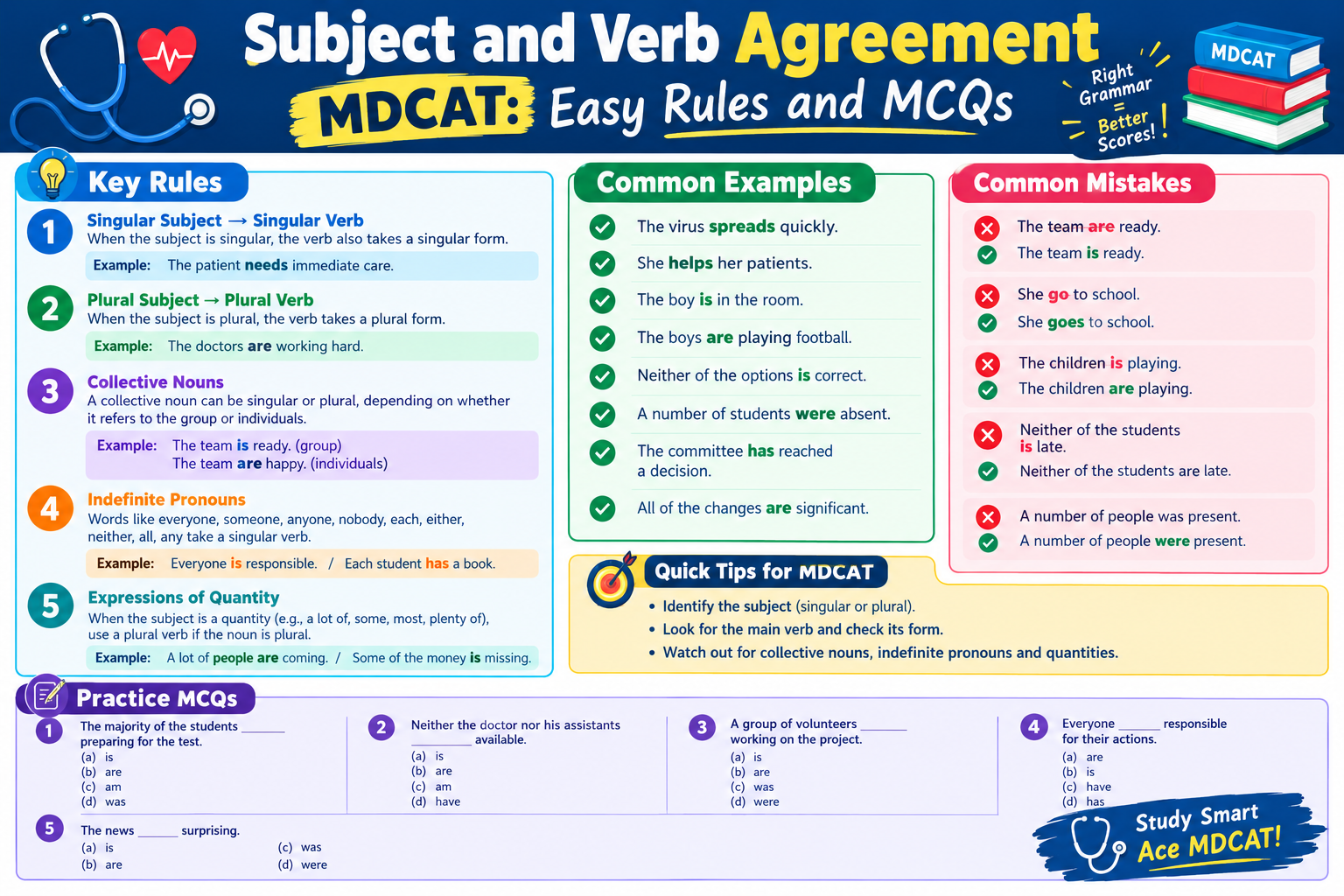
Subject and verb agreement MDCAT questions are some of the easiest marks in the English section. The rules are short, and the patterns repeat. As a result, you can learn them in about a week.
Many students skip English because biology, chemistry, and physics take most of their time. However, English marks count in the same way as every other mark. In a close merit list, a few extra marks can change your result.
In this guide, you will learn 15 simple rules and a fast 3-step method. You will also meet the medical words that confuse students. Finally, you will solve 30 practice MCQs with answers. We use easy words and short sentences, so you can read quickly and remember more.
Why Subject and Verb Agreement MDCAT Questions Are Worth Your Time
First, the topic follows clear rules. You do not need to memorize long theory. Second, the English section uses multiple-choice questions, so you only pick the right verb. Therefore, each question takes a few seconds once you know the tricks.
Moreover, this skill helps you in other places. For example, it improves your sentence correction answers and your writing. Please also check the latest official syllabus and past papers, because exam patterns can change. Still, subject and verb agreement stays useful in any pattern.
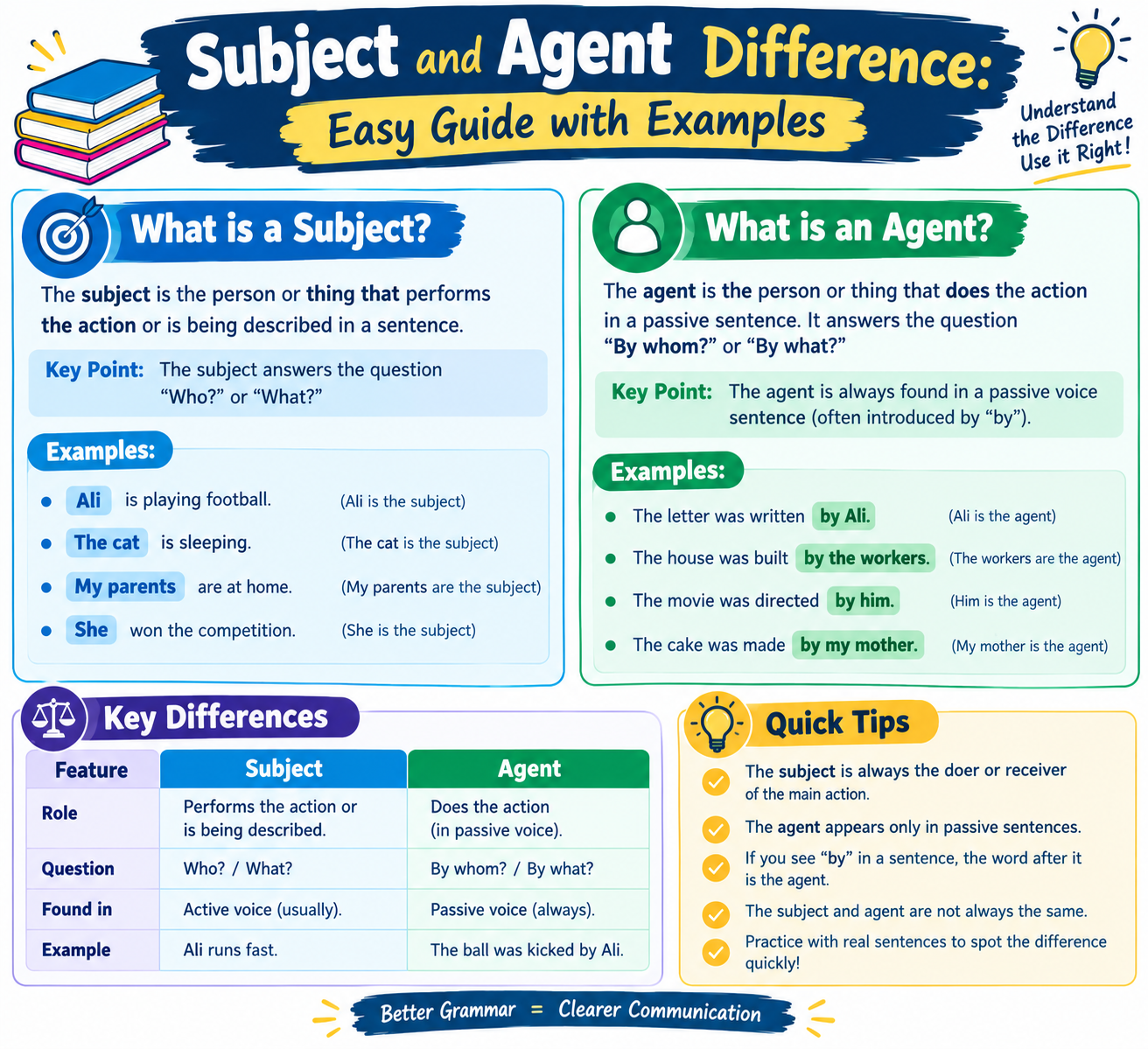
If you are new to grammar basics, read our guide on subject and object first. Later, try our subject-verb agreement guide for CSS, which goes deeper into the same topic. For extra practice, the Purdue OWL grammar section is also helpful.
What Subject and Verb Agreement Means
Every sentence has a subject and a verb. The subject is who or what the sentence is about. The verb shows the action or state. Agreement means that the verb matches the subject in number. In other words, one subject takes a singular verb, and many subjects take a plural verb.
For example, we say “The doctor checks the patient.” However, we say “The doctors check the patient.” Notice the small change. In the present tense, a singular verb usually ends in -s or -es.
The verbs be, have, and do change in special ways. Therefore, learn this table well.
| Subject | be | have | do |
|---|---|---|---|
| I | am | have | do |
| He / She / It | is | has | does |
| You / We / They | are | have | do |
Also remember that the past tense is easier. Most past verbs do not change. Only was and were change. As a result, most MCQ traps appear in the present tense.
A Fast 3-Step Method for Solving MCQs
In the exam, you do not have time to think for long. So use these three steps for every subject and verb agreement MDCAT question.
Step 1: Find the real subject. First, cross out the extra words between the subject and the verb. These are often phrases that start with of, in, on, with, or along with.
Step 2: Decide if it is singular or plural. Next, ask yourself if it is one thing or many things. Also watch for special words such as each, everyone, news, and scissors.
Step 3: Match the verb. Finally, choose the verb that fits. Then read the whole sentence once to check it.
Let us try it with this question: “The list of medicines (is / are) on the table.” First, cross out “of medicines.” Then you see that the real subject is list. Since list is singular, the answer is is. After a little practice, this takes about five seconds.
Subject and Verb Agreement MDCAT Rules 1 to 3: Spot the Real Subject
Rule 1: Ignore the words between the subject and the verb. This is the biggest trap in MCQs. Exam setters often place a plural noun next to the verb. Because of that, many students pick the wrong verb. For example, in “The level of sugar in the blood has increased,” the subject is level, not blood. In the same way, “The patients in the ward are sleeping” needs are, because the subject is patients.
Rule 2: Two subjects joined by and take a plural verb. For instance, we write “Fever and cough are common symptoms.” However, there is one exception. When both words name one thing, the verb stays singular. So we write “Bread and butter is a simple meal.”
Rule 3: Each and every take a singular verb. Even when a plural noun follows, the verb stays singular. For example, “Each of the students has a pen” is correct. Likewise, “Every doctor and nurse was present” is correct, even though it has the word and.
Rules 4 and 5: Singular and Plural Pronouns
Rule 4: Some pronouns are always singular. These words look like many people, but they act as one. They include everyone, everybody, everything, someone, anybody, nobody, nothing, either, neither, and each. Therefore, we write “Everyone needs water” and “Neither of the options is correct.”
Rule 5: Some pronouns are always plural. These are both, few, many, and several. For example, we say “Both of the nurses are ready” and “Few have passed this test.” Similarly, “Many of the cells are damaged” needs a plural verb.
A simple trick helps here. Most words that end in -one or -body, like everyone and nobody, are singular. On the other hand, words that mean two or more, like both and few, are plural.
Rules 6 and 7: Either…Or and Along With
Rule 6: With or and nor, follow the nearest subject. When subjects join with or, nor, either…or, or neither…nor, the verb agrees with the closest subject. For example, “Either the nurse or the doctors are late” uses are, because doctors is closest. If you swap them, the verb changes. So “Either the doctors or the nurse is late” uses is. As a quick tip, look only at the last subject before the verb.
Rule 7: Along with and as well as do not make a subject plural. These phrases add extra information, but they do not change the verb. Instead, the verb agrees with the first subject. For example, “The doctor, along with two nurses, is in the room.” In contrast, the word and makes a plural, as in “The doctor and two nurses are in the room.” Exam setters love this pair, so remember it well.
Rules 8 and 9: Collective Nouns and Words That End in S
Rule 8: Collective nouns are usually singular. A collective noun names a group, such as team, committee, staff, family, or class. When the group acts as one unit, the verb is singular. For example, “The team is ready for surgery.” Sometimes the members act separately, and then the verb is plural. However, this case is rare. Therefore, choose the singular verb when you feel unsure.
Rule 9: Some words end in S but are singular. Examples are news, mathematics, physics, economics, politics, measles, mumps, rabies, diabetes, and rickets. Because MDCAT students study science, you will see many of these words. For instance, we write “Diabetes is common in adults” and “Measles is a contagious disease.” In short, treat disease names and school subjects as singular.
Subject and Verb Agreement MDCAT Rules for Science Words
Many science words come from Latin and Greek, so they have special plural forms. If you do not know them, you may pick the wrong verb. Here are the most common ones for subject and verb agreement MDCAT questions.
| Singular | Plural | Example |
|---|---|---|
| bacterium | bacteria | The bacteria are harmful. |
| criterion | criteria | The criteria are strict. |
| phenomenon | phenomena | These phenomena are rare. |
| diagnosis | diagnoses | The diagnoses were correct. |
| analysis | analyses | Both analyses are useful. |
| nucleus | nuclei | The nuclei are visible. |
| vertebra | vertebrae | The vertebrae protect the spinal cord. |
| stimulus | stimuli | The stimuli were strong. |
| hypothesis | hypotheses | The hypotheses were tested. |
| datum | data | The data are clear. |
A few notes will help. First, data is plural in formal science writing, so we write “The data are clear.” Many people also use it as a singular word in daily English. Therefore, follow the options in the question, and choose the plural when both seem possible.
Second, the words series and species look the same in singular and plural. In this case, read the other words in the sentence. Finally, statistics is singular when it means the subject and plural when it means numbers.
Rules 10 to 13: Plural Nouns, Amounts, and Numbers
Rule 10: Some nouns are always plural. Scissors, forceps, glasses, trousers, people, police, and cattle all take plural verbs. For example, “The forceps are sterile.” With the phrase a pair of, however, the verb follows pair. So we write “A pair of scissors is on the tray.”
Rule 11: Time, money, and distance are singular. When a plural number names one total, use a singular verb. For example, “Ten minutes is enough for this test.”
Rule 12: Fractions follow the noun after of. If that noun is singular, use a singular verb. If it is plural, use a plural verb. Compare “Half of the blood was lost” with “Half of the patients were cured.” Words like all, some, most, and none work the same way.
Rule 13: A number of is plural, but the number of is singular. First, a number of means many, so we write “A number of patients are waiting.” Second, the number of talks about one count, so we write “The number of patients is rising.” This pair appears often in MCQs, so learn it by heart.
Rules 14 and 15: There Is and One of the
Rule 14: In there is and there are, the real subject comes after the verb. The word there is not the subject. Instead, match the verb to the noun that follows. For example, “There is one bed free” and “There are three beds free.” The same idea works in questions. So we write “Where are the reports?”
Rule 15: One of the takes a plural verb, but the only one of the takes a singular verb. When who, which, or that starts a clause, the verb matches the noun before it. Therefore, we write “She is one of the nurses who work at night.” Here the group is nurses. On the other hand, we write “She is the only one of the nurses who works at night.” Here the subject is one person.
More Tricky Cases to Remember
First, a gerund or an infinitive as the subject takes a singular verb. For example, “Smoking harms the lungs.” Second, book titles and country names are singular, as in “The United States has many universities.” Third, many a and more than one take singular verbs, even though they sound plural. For instance, “Many a patient has recovered here.” Finally, the plus an adjective names a group and takes a plural verb, as in “The sick need care.”
Common Subject and Verb Agreement MDCAT Mistakes
Students lose marks for the same few errors. Fortunately, you can avoid them with a little care. Check the table below before you finish each practice set.
| Wrong | Right | Reason |
|---|---|---|
| The quality of these medicines are poor. | The quality of these medicines is poor. | The subject is quality. |
| The doctor, along with the nurses, are here. | The doctor, along with the nurses, is here. | Along with adds no plural. |
| Diabetes are a serious disease. | Diabetes is a serious disease. | Disease names are singular. |
| Each of the students have passed. | Each of the students has passed. | Each is singular. |
| The number of cases are growing. | The number of cases is growing. | The number of is singular. |
| The bacteria is dead. | The bacteria are dead. | Bacteria is plural. |
In addition, keep a small notebook for your own mistakes. Reading your errors is one of the best ways to remember the rules.
Quick Revision Table for the Exam
Read this table on the night before your test. It sums up every rule in one place.
| Situation | Verb | Example |
|---|---|---|
| Extra words between subject and verb | Ignore them | The list of drugs is long. |
| X and Y | Plural | Fever and cough are common. |
| Each, every, everyone, nobody | Singular | Everyone is here. |
| Both, few, many, several | Plural | Few are ready. |
| Either…or, neither…nor | Nearest subject | Neither he nor they are right. |
| Along with, as well as | First subject | The doctor, as well as the nurses, is here. |
| Team, staff, committee | Usually singular | The team is ready. |
| News, physics, diabetes | Singular | Diabetes is common. |
| Scissors, forceps, police | Plural | The forceps are ready. |
| Time, money, distance | Singular | Ten minutes is enough. |
| A number of | Plural | A number of cases are new. |
| The number of | Singular | The number of cases is low. |
| There is, there are | Subject after verb | There are two beds. |
| Bacteria, criteria, phenomena | Plural | The criteria are fixed. |
Seven-Day Study Plan for Subject and Verb Agreement MDCAT
You do not need a whole month. Instead, follow this simple plan for 30 minutes a day.
On day 1, learn the basic rule and the be, have, and do table. Then solve 10 easy questions. On day 2, study Rules 1 to 3, and solve 15 questions. On day 3, study Rules 4 to 7. After that, do 15 more questions.
On day 4, study Rules 8 to 13. Next, on day 5, learn the science words table and make flashcards for the plurals. On day 6, solve all 30 practice MCQs below with a timer. Finally, on day 7, review every mistake and read the revision table again.
Subject and Verb Agreement MDCAT Practice MCQs
Choose the correct word in each question. Try to finish every question in under 20 seconds. The answers come right after the questions.
Set A: Questions 1 to 15
- The results of the test (is / are) ready.
- Each of the patients (has / have) a file.
- Neither the doctor nor the nurses (was / were) informed.
- Diabetes (is / are) a common disease.
- The team of surgeons (is / are) ready.
- A number of students (is / are) absent today.
- The number of students (is / are) small.
- The scissors (is / are) on the tray.
- Everyone in the wards (was / were) given a mask.
- The doctor, along with two nurses, (is / are) in the room.
- Measles (is / are) a viral disease.
- There (is / are) many reasons for this problem.
- Ten minutes (is / are) enough for the test.
- The bacteria (is / are) harmful.
- Few (has / have) understood the lesson.
Set B: Questions 16 to 30
- Neither of the two reports (is / are) complete.
- Either the nurse or the doctors (is / are) responsible.
- The quality of these medicines (is / are) poor.
- Both of the answers (is / are) wrong.
- Mathematics (is / are) taught in every school.
- Half of the food (was / were) wasted.
- Half of the tablets (was / were) missing.
- She is one of the nurses who (work / works) at night.
- The criteria (is / are) clear.
- Where (is / are) the reports?
- Many a patient (has / have) recovered here.
- The police (is / are) investigating the case.
- Smoking and drinking (harm / harms) the body.
- The news from the hospitals (is / are) good.
- The medicines on the shelf (is / are) expensive.
Answers and Short Explanations
Answers for Set A
- are, because the subject is results.
- has, because each is singular.
- were, because the nearest subject is nurses.
- is, because diabetes is singular.
- is, because the real subject is team.
- are, because a number of means many.
- is, because the number of is singular.
- are, because scissors is plural.
- was, because everyone is singular.
- is, because along with does not change the verb.
- is, because measles is singular.
- are, because the real subject is reasons.
- is, because ten minutes is one period of time.
- are, because bacteria is plural.
- have, because few is plural.
Answers for Set B
- is, because neither is singular.
- are, because the nearest subject is doctors.
- is, because the subject is quality.
- are, because both is plural.
- is, because mathematics is singular.
- was, because food is singular.
- were, because tablets is plural.
- work, because one of the nurses who takes a plural verb.
- are, because criteria is plural.
- are, because the real subject is reports.
- has, because many a takes a singular verb.
- are, because police is plural.
- harm, because two activities joined by and are plural.
- is, because the subject is news.
- are, because the subject is medicines.
If you score 26 or more, you are in excellent shape. If you score between 20 and 25, review your mistakes and try again. If you score below 20, reread the rules and retry the set after two days.
FAQs on Subject and Verb Agreement MDCAT
Is subject and verb agreement MDCAT important?
Yes, it is a very useful topic for the English section. The rules are clear, so you can practice them quickly. Please also check the official syllabus and past papers to see how English is tested in your year.
How can I solve subject and verb agreement MDCAT MCQs fast?
Use the 3-step method. First, find the real subject. Next, decide if it is singular or plural. Finally, pick the matching verb. Practice with a timer to build speed.
What does subject and verb agreement mean for MDCAT students?
It means the verb must match the subject in number. A singular subject needs a singular verb, and a plural subject needs a plural verb. For example, we say “The nurse helps” and “The nurses help.”
Is data singular or plural?
In formal science writing, data is plural, so we write “The data are clear.” However, many people use it as singular in daily English. In a test, follow the options, and choose the plural if both seem possible.
Is bacteria singular or plural?
Bacteria is plural. The singular form is bacterium. So we write “The bacteria are harmful” and “This bacterium is harmful.”
Are disease names like diabetes and measles singular?
Yes. Disease names that end in S take singular verbs. Examples are diabetes, measles, mumps, rabies, and rickets. For instance, we say “Measles is dangerous.”
What is the difference between a number of and the number of?
A number of means many, so it takes a plural verb. The number of talks about one count, so it takes a singular verb. For example, “A number of patients are waiting,” but “The number of patients is high.”
Does along with make a subject plural?
No. Along with, as well as, and together with do not change the verb. In “The doctor, along with the nurses, is here,” the verb agrees with doctor.
What does either…or do to the verb?
The verb agrees with the subject nearest to it. In “Either the nurse or the doctors are late,” the verb is plural because doctors is closest.
How many days do I need for subject and verb agreement MDCAT rules?
Most students learn all 15 rules in about a week. Study for 30 minutes a day, and follow the seven-day plan above. In addition, solve all 30 practice MCQs.
Conclusion: Final Tips for Subject and Verb Agreement MDCAT
Subject and verb agreement MDCAT questions reward students who practice a little each day. The main steps are simple. Find the real subject, decide if it is singular or plural, and match the verb.
On exam day, keep these points in mind. First, ignore the extra words between the subject and the verb. Second, remember that each, everyone, and neither are singular. Third, remember that both, few, and many are plural. Finally, treat diabetes, measles, and physics as singular, and treat bacteria and criteria as plural.