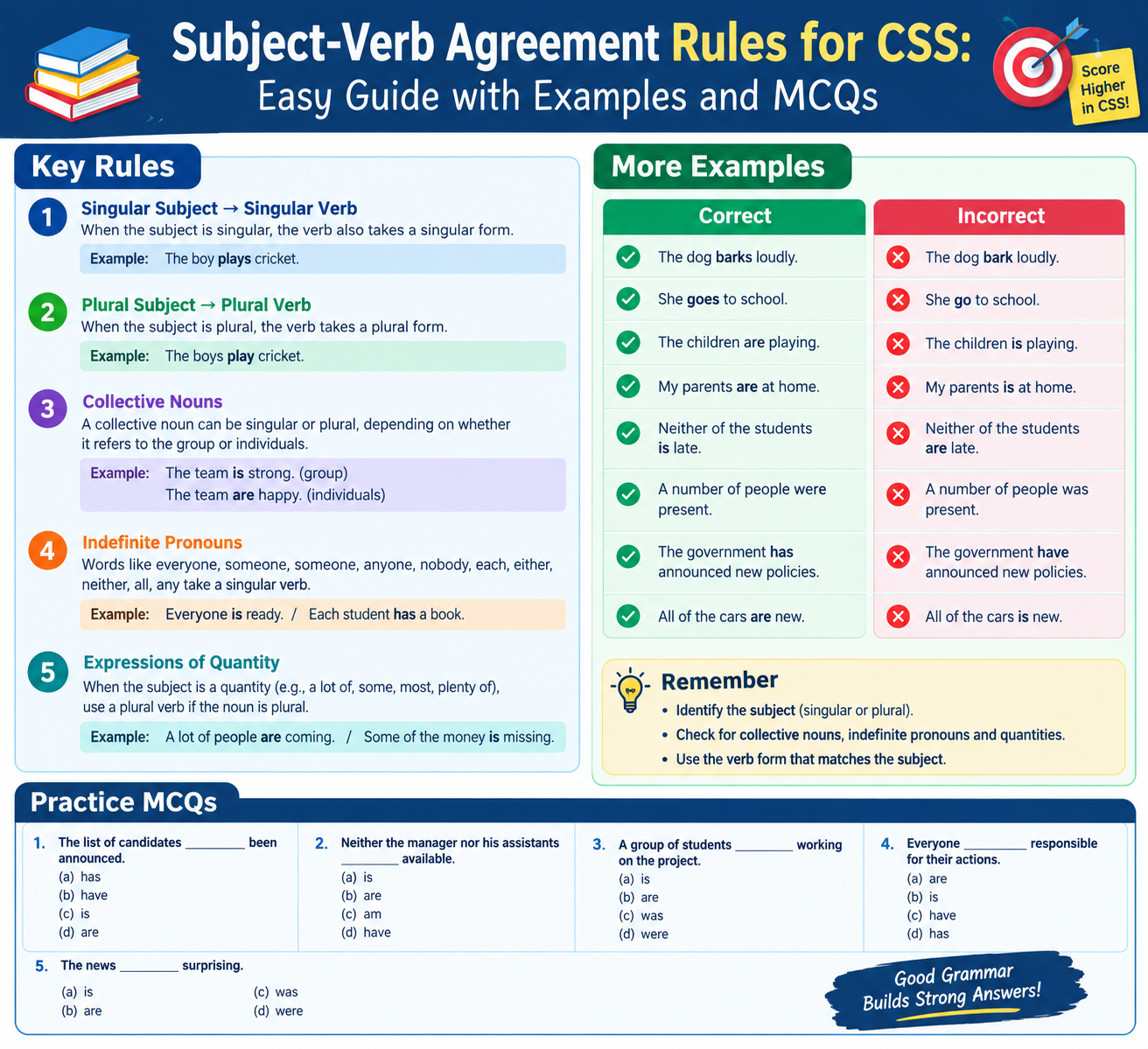
The CSS English exam tests your grammar, and subject-verb agreement is one of the topics that appears again and again. It shows up in the English precis and composition paper, in sentence correction, and in your own essay writing. A single agreement mistake can lower your marks and make your writing look weak.
The good news is that the idea is simple. The verb must match the subject. If the subject is singular, the verb is singular. If the subject is plural, the verb is plural.
The hard part is that real sentences are not always simple. Extra words come between the subject and the verb. Subjects are joined by or, nor, and along with. Some nouns look plural but act singular. Some look singular but act plural. The exam setters know these traps, and they use them.
In this guide, you will learn 25 easy rules, each with clear examples. At the end, you will find 20 practice questions with answers. We use simple words so you can learn quickly and remember well.
If you are not yet sure what a subject is, first read our guide on subject and object. It will make this article much easier.
What Is Subject-Verb Agreement?
Subject-verb agreement means that the subject and the verb in a sentence must match in number. Number means one (singular) or more than one (plural).
- The boy plays football. (singular subject, singular verb)
- The boys play football. (plural subject, plural verb)
For most present-tense verbs, the singular form ends in -s or -es, and the plural form does not.
| Subject | Verb | Example |
|---|---|---|
| I | play | I play cricket. |
| You | play | You play cricket. |
| He / She / It | plays | She plays cricket. |
| We | play | We play cricket. |
| They | play | They play cricket. |
The verbs be, have, and do change in special ways:
| Subject | be (present) | have | do |
|---|---|---|---|
| I | am | have | do |
| He / She / It | is | has | does |
| You / We / They | are | have | do |
Learn this table well. Many CSS errors come from mixing up is and are, has and have, and does and do.
Rule 1: A Singular Subject Takes a Singular Verb
This is the base rule. One person or thing takes a singular verb.
- The teacher explains the lesson.
- A river flows through the city.
- My sister is a lawyer.
Rule 2: A Plural Subject Takes a Plural Verb
More than one person or thing takes a plural verb.
- The teachers explain the lesson.
- Rivers flow to the sea.
- My sisters are lawyers.
Rule 3: Ignore the Words Between the Subject and the Verb
This is the most common exam trap. Words that come between the subject and the verb do not change the verb. Cross them out in your mind.
- The box of chocolates is on the table. (not are)
- The students in the front row are very serious. (not is)
- The price of vegetables has increased. (not have)
- The cost of the books, the pens, and the bags is high.
Find the real subject first. Then match the verb to it. Phrases that start with of, in, on, at, with, and for are usually just extra information.
Rule 4: Two Subjects Joined by “And” Take a Plural Verb
When two subjects are joined by and, the verb is plural.
- Ali and Hamza are brothers.
- Reading and writing improve your skills.
- A pen and a notebook are on the desk.
Rule 5: Two Words for One Thing Take a Singular Verb
Sometimes and joins two words that name one person, one thing, or one idea. In that case, the verb is singular.
- Bread and butter is my favorite breakfast.
- Rice and curry is a popular dish.
- The poet and writer has won an award. (one person who is both)
Watch the little word the. If it is used before each noun, they are two people: “The poet and the writer have arrived.”
Rule 6: Each and Every Take a Singular Verb
When each or every comes before the subject, the verb is singular, even with and.
- Each boy and girl has a book.
- Every man, woman, and child was safe.
- Each of the players is ready.
Rule 7: Either…Or and Neither…Nor Follow the Nearest Subject
When subjects are joined by or, nor, either…or, or neither…nor, the verb agrees with the subject closest to it. This is called the proximity rule.
- Either the teacher or the students are wrong. (students is closer)
- Either the students or the teacher is wrong. (teacher is closer)
- Neither Ali nor his brothers were present.
- Neither the boys nor the girl was late.
A good tip for your own writing: put the plural subject last. It sounds smoother.
Rule 8: “Along With”, “As Well As”, “Together With”, and “In Addition To” Do Not Change the Verb
These phrases add extra information. They do not make the subject plural. The verb agrees with the first subject.
- The captain, along with his team, is coming.
- The teacher, as well as the students, was happy.
- Sara, together with her friends, has won.
- The manager, in addition to his workers, needs a rest.
Compare with and:
- The captain and his team are coming.
This is a favorite CSS question. Remember: and adds, but along with only mentions.
Rule 9: Some Indefinite Pronouns Are Always Singular
These words look like they mean many people, but they take a singular verb:
each, every, everyone, everybody, everything, someone, somebody, something, anyone, anybody, anything, no one, nobody, nothing, one, either, neither
- Everyone has a right to learn.
- Somebody is knocking at the door.
- Nobody was at home.
- Neither of the answers is correct.
- Each of the girls has a prize.
Rule 10: Some Indefinite Pronouns Are Always Plural
These words always take a plural verb:
both, few, many, several, others
- Both of the boys are clever.
- Few were present at the meeting.
- Many have left the city.
- Several are missing.
Rule 11: Some Pronouns Can Be Singular or Plural
The words all, some, any, none, most, more, half, and plenty depend on the noun that comes after of.
- Some of the water is dirty. (water is singular)
- Some of the books are missing. (books is plural)
- All of the cake was eaten.
- All of the cakes were eaten.
- Most of the money was spent.
- Most of the people were happy.
Look at the noun after of, and match the verb to it.
Rule 12: “None” Can Take Either a Singular or a Plural Verb
None means “not one” or “not any”. Both forms are accepted. In the CSS exam, the safest choice is to follow the meaning.
- None of the water is left. (a single mass)
- None of the students have come. (many separate people)
- None of the students has come. (also correct, and more formal)
If the question gives only one correct option, choose the one that matches the noun after of.
Rule 13: Collective Nouns Can Be Singular or Plural
A collective noun names a group, like team, family, committee, class, jury, audience, staff, crowd, government, and army.
- If the group acts as one unit, use a singular verb.
- If the members act separately, use a plural verb.
Singular (one unit):
- The team is winning the match.
- The committee has made its decision.
- The class starts at nine.
Plural (separate members):
- The team are arguing among themselves.
- The committee have different opinions.
- The family are wearing their new clothes.
In most exam questions, the singular form is the safe answer.
Rule 14: Some Nouns Look Plural but Are Singular
A group of nouns end in -s, but they take a singular verb.
news, mathematics, physics, economics, politics, athletics, measles, mumps, civics, ethics, linguistics, gymnastics
- The news is good today.
- Mathematics is my favorite subject.
- Physics was hard for him.
- Politics is a risky career.
- Measles is a disease.
This is a very common exam trap. Students see the s and choose a plural verb.
A small note: words like economics, politics, and ethics can take a plural verb when they mean personal views. For example, “His politics are well known.” But for exam purposes, use singular for the subject name.
Rule 15: Some Nouns Are Always Plural
Some nouns are always plural and always take a plural verb. Many of them are tools or clothes with two parts.
scissors, trousers, pants, jeans, glasses, spectacles, pliers, tongs, shorts, clothes, goods, riches, thanks, belongings, savings, premises
- My scissors are sharp.
- Your trousers are dirty.
- The glasses were on the table.
To make these singular, use the phrase a pair of. But then the verb follows pair.
- A pair of scissors is on the desk.
- Two pairs of trousers are in the shop.
The words people, police, cattle, and poultry are also plural.
- The police are investigating.
- The cattle graze in the field.
- The people were angry.
Rule 16: Amounts, Time, Distance, and Money Are Singular
When a plural number names one total amount, the verb is singular.
- Fifty rupees is a fair price.
- Ten kilometers is a long walk.
- Five years is a long time.
- Two hours was not enough.
- Ten thousand dollars is a large sum.
But when you mean the separate items, use a plural verb.
- Ten rupees were found on the floor. (ten separate coins or notes)
Rule 17: Fractions and Percentages Follow the Noun After “Of”
For fractions and percentages, look at the noun after of.
- Half of the pizza is gone.
- Half of the students are absent.
- Forty percent of the land is green.
- Forty percent of the voters are young.
- Two-thirds of the work has been done.
Rule 18: “A Number Of” Is Plural, but “The Number Of” Is Singular
This pair is a classic exam question.
- A number of students are absent. (means “many”, so plural)
- The number of students is growing. (the number is one thing, so singular)
It works the same way for a majority of / the majority, and a variety of / the variety of:
- A variety of fruits are sold here.
- The variety of fruits is amazing.
Rule 19: In “There Is” and “There Are”, the Real Subject Comes After the Verb
In sentences that start with there or here, the word there is not the subject. The real subject comes later. Match the verb to that real subject.
- There is a book on the table.
- There are two books on the table.
- There was a man and a woman at the door. (The verb agrees with the nearest, which is “man”, in careful writing.)
- Here come the buses.
- Here is your key.
In daily speech, many people say “There’s two books.” But in an exam, write “There are two books.”
Rule 20: In Inverted Sentences, Find the Real Subject
Sometimes the verb comes before the subject, such as in questions or in formal writing. Rearrange the sentence in your mind.
- Where are the keys? (The keys are where.)
- Beside the river stands a temple. (A temple stands beside the river.)
- Never have I seen such a view. (I have never seen such a view.)
- On the shelf were three old books.
Rule 21: Relative Pronouns “Who”, “Which”, and “That” Agree with Their Antecedent
When who, which, or that is the subject of a clause, the verb matches the noun it points back to (the antecedent).
- She is a girl who loves books. (girl is singular)
- They are girls who love books. (girls is plural)
- This is the book that helps me.
The tricky case is with the phrase “one of the”:
- She is one of the girls who love books. (the group is girls, so plural)
- He is one of the students who have passed.
But with “the only one of the”, the verb is singular:
- He is the only one of the students who has passed.
In simple words: with one of the, the verb is plural. With the only one of the, the verb is singular.
Rule 22: Gerunds, Infinitives, and Clauses Take a Singular Verb
When the subject is a gerund (verb + ing), an infinitive (to + verb), or a whole clause, the verb is singular.
- Swimming is good exercise.
- Walking and running are healthy. (two separate activities joined by and, so plural)
- To err is human.
- What he said was true.
- Whether he will come is unknown.
Rule 23: Titles and Names Take a Singular Verb
The title of a book, film, or company is singular, even if it looks plural.
- The Arabian Nights is a famous book.
- The United States has a large economy.
- The Netherlands is a flat country.
- Times of India is a newspaper.
Rule 24: “Many a” and “More Than One” Take a Singular Verb
These phrases have a plural meaning, but the grammar is singular.
- Many a student has failed this test.
- More than one student has failed this test.
Compare with “Many students have failed.” Here many is a plural pronoun.
Rule 25: “The” Plus an Adjective Takes a Plural Verb
When the is used with an adjective to name a group of people, the verb is plural.
- The poor need our help.
- The rich are not always happy.
- The young have energy.
- The injured were taken to hospital.
But when it names an idea, it is singular: “The unknown frightens many people.”
Quick Reference Chart
| Situation | Verb | Example |
|---|---|---|
| Words between subject and verb | Ignore them | The box of toys is here. |
| Subjects joined by and | Plural | Ali and Sara are here. |
| One idea joined by and | Singular | Bread and butter is ready. |
| Each / every | Singular | Each student has a pen. |
| Or / nor | Nearest subject | Neither he nor they are right. |
| Along with / as well as | First subject | Ali, along with Sara, is here. |
| Everyone, somebody, nobody | Singular | Everyone is present. |
| Both, few, many, several | Plural | Few were present. |
| News, mathematics, physics | Singular | Mathematics is hard. |
| Scissors, trousers, police | Plural | The police are here. |
| Money, time, distance | Singular | Ten years is long. |
| A number of | Plural | A number of boys are here. |
| The number of | Singular | The number of boys is low. |
| There is / there are | Real subject after verb | There are two cars. |
| Gerund or infinitive subject | Singular | Reading is fun. |
Common Mistakes in CSS Exams
Here are the mistakes that cost students the most marks.
1. Choosing the noun next to the verb.
- Wrong: The quality of these mangoes are high.
- Right: The quality of these mangoes is high.
2. Treating “along with” like “and”.
- Wrong: The principal, along with the teachers, are present.
- Right: The principal, along with the teachers, is present.
3. Forgetting that “each” is singular.
- Wrong: Each of the boys have a bike.
- Right: Each of the boys has a bike.
4. Using a plural verb with subjects like “news” and “mathematics”.
- Wrong: The news are shocking.
- Right: The news is shocking.
5. Mixing up “a number of” and “the number of”.
- Wrong: The number of cars are increasing.
- Right: The number of cars is increasing.
6. Missing the real subject after “there”.
- Wrong: There is many problems.
- Right: There are many problems.
7. Wrong verb after “one of the”.
- Wrong: She is one of the girls who loves art.
- Right: She is one of the girls who love art.
5 Smart Tips for the CSS Exam
- Underline the real subject first. Cross out phrases that start with of, in, with, along with, and as well as.
- Say the sentence in a short form. “The cost of the books is high” becomes “Cost is high.” This makes the match easy to hear.
- Check the tense. Past tense verbs, except was and were, do not change for number. Only was/were matters in the past.
- Learn the special word lists. Keep short lists of singular-only words (news, physics, each) and plural-only words (scissors, police, cattle).
- Practice every day. Solve five questions a day, and check the answers. In two weeks, you will see a big change.
Practice Questions
Choose the correct verb. Answers are given after the questions.
- The list of items (is / are) on the desk.
- Neither the teacher nor the students (was / were) ready.
- Mathematics (is / are) a difficult subject for him.
- The captain, along with his players, (is / are) arriving soon.
- Each of the boys (has / have) a ticket.
- A number of guests (is / are) waiting outside.
- The number of guests (is / are) small.
- Five years (is / are) a long time to wait.
- There (is / are) three books on the shelf.
- She is one of the doctors who (works / work) at night.
- The police (has / have) caught the thief.
- Either Ali or his friends (is / are) at fault.
- Everybody (was / were) happy with the result.
- Half of the cake (is / are) gone.
- Bread and butter (is / are) ready.
- The poor (needs / need) our help.
- Many a man (has / have) lost his way.
- My trousers (is / are) torn.
- Swimming and cycling (is / are) good for health.
- Half of the students (was / were) absent.
Answers
- is (subject is list)
- were (nearest subject is students)
- is (mathematics is singular)
- is (along with does not change the verb)
- has (each is singular)
- are (a number of is plural)
- is (the number of is singular)
- is (time as one period is singular)
- are (real subject is books)
- work (one of the doctors who takes a plural verb)
- have (police is plural)
- are (nearest subject is friends)
- was (everybody is singular)
- is (cake is singular)
- is (one dish, so singular)
- need (the poor is plural)
- has (many a takes a singular verb)
- are (trousers is plural)
- are (two activities joined by and)
- were (students is plural)
If you got 16 or more right, you are in good shape. If you scored less, read the rules again and try a second time.
Frequently Asked Questions (FAQs)
What is subject-verb agreement in simple words?
It means the verb must match the subject in number. A singular subject needs a singular verb, and a plural subject needs a plural verb. For example, “The bird sings” and “The birds sing.”
Why is subject-verb agreement important for the CSS exam?
The CSS English paper checks your grammar in sentence correction, error spotting, and your own writing. Agreement errors are easy for examiners to see, and they reduce your marks. Strong agreement skills make your essay and precis cleaner.
What is the easiest way to find the subject of a sentence?
Find the verb first. Then ask “Who?” or “What?” before it. The answer is the subject. Also, ignore phrases that begin with of, in, on, or with, because they are usually not the subject. You can learn more in our guide on subject in detail.
Is “everyone” singular or plural?
Everyone is singular. Write “Everyone is here,” not “Everyone are here.” The same is true for everybody, someone, anybody, nobody, and no one.
Is “news” singular or plural?
It is singular. Write “The news is good.” Other singular words that end in s are mathematics, physics, economics, politics, and measles.
What is the proximity rule?
The proximity rule says that when subjects are joined by or, nor, either…or, or neither…nor, the verb agrees with the subject nearest to it. In “Neither the boy nor his parents were there,” the verb is plural because parents is closest.
Does “as well as” make the subject plural?
No. As well as, along with, together with, and in addition to do not change the verb. In “The teacher, as well as the students, is happy,” the verb agrees with teacher.
When do I use “a number of” and “the number of”?
Use “a number of” with a plural verb because it means “many.” Use “the number of” with a singular verb because it talks about one number. Example: “A number of boys are absent. The number of boys is small.”
Are collective nouns singular or plural?
Both are possible. If the group acts as one unit, the verb is singular: “The team is ready.” If the members act on their own, the verb is plural: “The team are arguing.” In exams, the singular choice is usually correct.
How do I handle “one of the” in a sentence?
With “one of the + plural noun + who/that,” the verb is plural: “She is one of the girls who play chess.” With “the only one of the,” the verb is singular: “She is the only one of the girls who plays chess.”
Is “there is” or “there are” correct before a plural noun?
Use “there are” before a plural noun. The word there is not the subject. The real subject comes after the verb. For example, “There are five chairs in the room.”
How much time do I need to learn these rules?
Most students can learn all 25 rules in about two weeks if they study for 30 minutes a day and solve a few practice questions. Keep a small notebook of tricky words and check it each day.
Conclusion
Subject-verb agreement may look hard at first, but the main idea is easy. Find the real subject, decide if it is singular or plural, and match the verb. Most exam traps are about hiding the real subject, so train your eyes to spot it.
Here is a quick recap of the most tested points:
- Ignore the words between the subject and the verb.
- Remember that each, every, everyone, nobody, and neither are singular.
- Use the proximity rule for or and nor.
- Remember that along with and as well as do not make a plural.
- Learn the singular words ending in s, such as news and mathematics.
- Know the difference between a number of and the number of.
Practice these every day, and you will answer agreement questions with confidence in the CSS exam and in your own writing.
Read next on subjectandscale.com:
- Subject and Object: Easy Guide with Examples
- Subject-Verb Agreement for MDCAT
- Subject and Agent: What Is the Difference?
- Subject in Detail: Types of Subject and Subject Area
2 thoughts on “Subject-Verb Agreement Rules for CSS: Easy Guide with Examples and MCQs”