This guide is for general learning, and it is not official advice. Scaling numbers change every year. Please check the current VTAC and VCAA websites for official figures. This article uses information available in October 2026.
Subject and scale VCE is one of the most searched topics among Victorian students. Many students hear that some subjects “scale up” and others “scale down.” However, few people explain what that means in simple words.
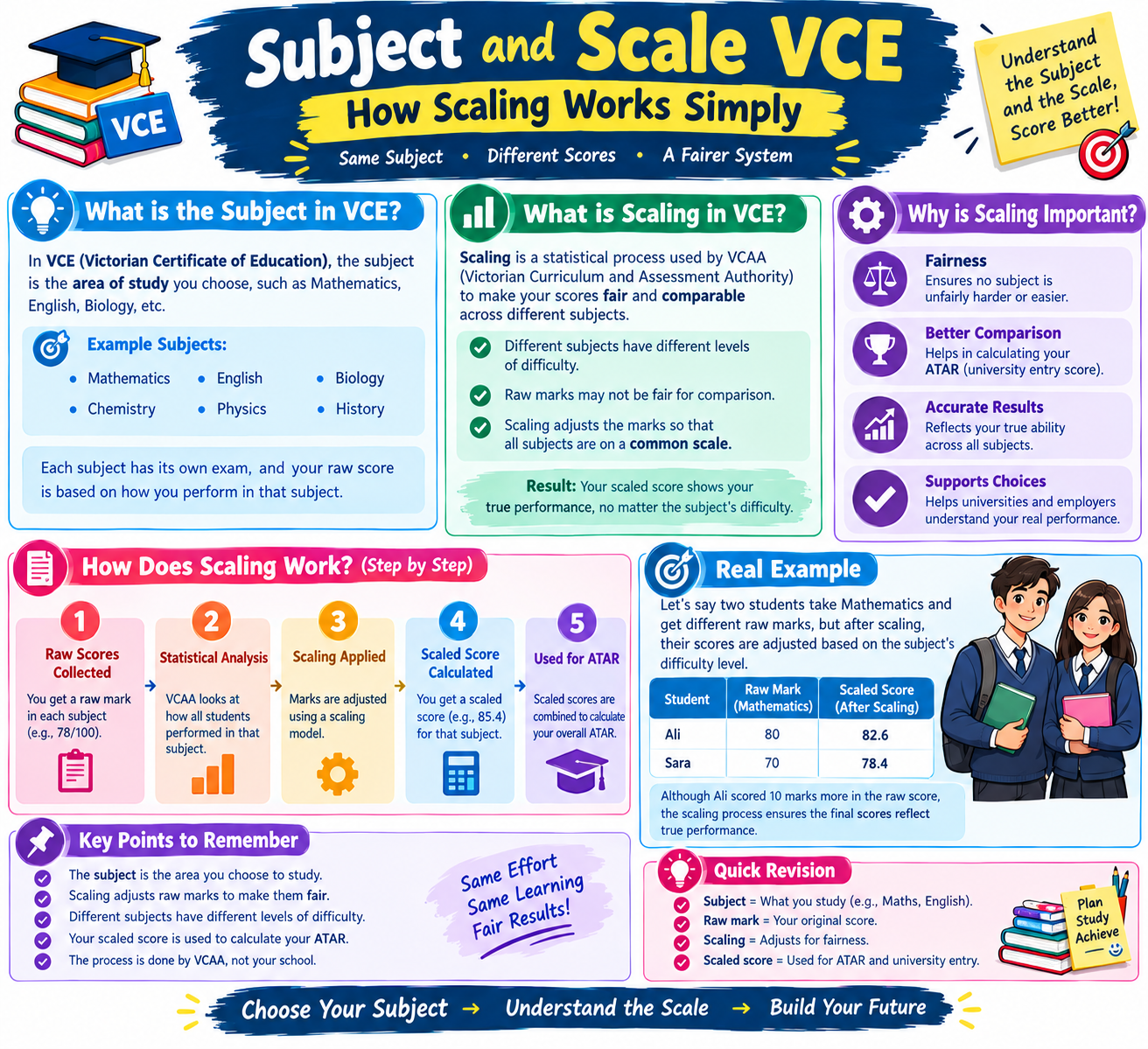
Here is the short answer. In the VCE, each subject gives you a study score. Then the Victorian Tertiary Admissions Centre (VTAC) adjusts that score so that results in different subjects can be compared fairly. This adjustment is called scaling. After that, VTAC adds your best scaled scores together and turns the total into your ATAR.
In this guide, you will learn each step, from study score to ATAR. You will see a worked example, clear myths and facts, and practice questions with answers. We use easy words and short sentences, so you can read quickly and remember more.
Subject and Scale VCE in One Minute
First, learn the key terms. This table explains them in simple words.
| Term | Simple meaning |
|---|---|
| VCE | Victorian Certificate of Education, the senior school certificate in Victoria |
| VCAA | The authority that runs the VCE and sets study scores |
| Study score | Your result in one subject, from 0 to 50 |
| VTAC | The centre that scales scores and calculates the ATAR |
| Scaled study score | Your study score after VTAC adjusts it |
| Aggregate | The total of your best scaled scores |
| ATAR | Your rank against other students, shown from 0 to 99.95 |
Now keep one idea in mind. Scaling changes the number that goes into your ATAR, but it does not change your study score on your result slip.
Step 1: What Is a Study Score?
A study score is the result that VCAA gives you for each Unit 3 and 4 subject. It shows how well you did compared with all other students in that subject.
Study scores follow a bell-shaped pattern. The average is 30, and most scores sit between about 23 and 37. Because of this, a score of 30 means you did about as well as the typical student in that subject. A score of 40 means you did very well. The top score is 50.
However, a study score tells you only how you ranked inside one subject. It does not tell you how strong the other students in that subject were. That is why scaling comes next.
Why Does Scaling Exist?
Imagine two subjects. In subject A, many of the students are very strong across all their studies. In subject B, the students are more mixed. Now imagine that you score 30 in both. Does 30 mean the same thing in each subject?
Not quite. In subject A, you beat many strong students to earn that 30. In subject B, you beat a more mixed group. Therefore, a fair system should treat the first 30 as slightly stronger.
That is the reason for scaling. VTAC describes it as an adjustment for the strength of competition in each subject. As a result, students can choose subjects they enjoy, and the ATAR still compares them fairly.
You can read the official description on the VTAC ATAR and scaling page.
Subject and Scale VCE: How Scaling Works Step by Step
Here is the process in plain words. It has four steps.
Step 1: VCAA sends study scores to VTAC. Every student with a study score is included.
Step 2: VTAC looks at each subject’s group of students. It checks how those students did in all their other VCE subjects.
Step 3: VTAC compares each group with the whole state. If the students in a subject did better than average in their other subjects, the subject’s scores scale up. If they did worse than average in their other subjects, the scores scale down.
Step 4: VTAC produces scaled study scores. These are the numbers used in your aggregate.
Notice what scaling does not do. It does not judge how hard the subject content is. Instead, it looks at the strength of the students who took it. Also, it does not depend on your own result alone. It depends on the group.
Because the groups change every year, scaling changes every year too. VTAC publishes its Scaling Report each December with the official figures.
A Look at Scaled Scores in Practice
To see how scaling changes numbers, look at this example. Some tutoring websites report that, in the 2025 scaling, a study score of 40 changed as shown below. These are examples only, and the real figures change every year.
| Subject | Study score | Reported scaled score |
|---|---|---|
| Specialist Mathematics | 40 | About 51 |
| Mathematical Methods | 40 | About 46 |
| English | 40 | About 39 |
| General Mathematics | 40 | About 38 |
So the same study score of 40 turned into different scaled scores. In the first two subjects, the score moved up. In the last two, it moved slightly down.
Please note that these numbers come from third-party sources. Always check the official VTAC Scaling Report for exact values.
Do Subjects Always Scale Up or Down?
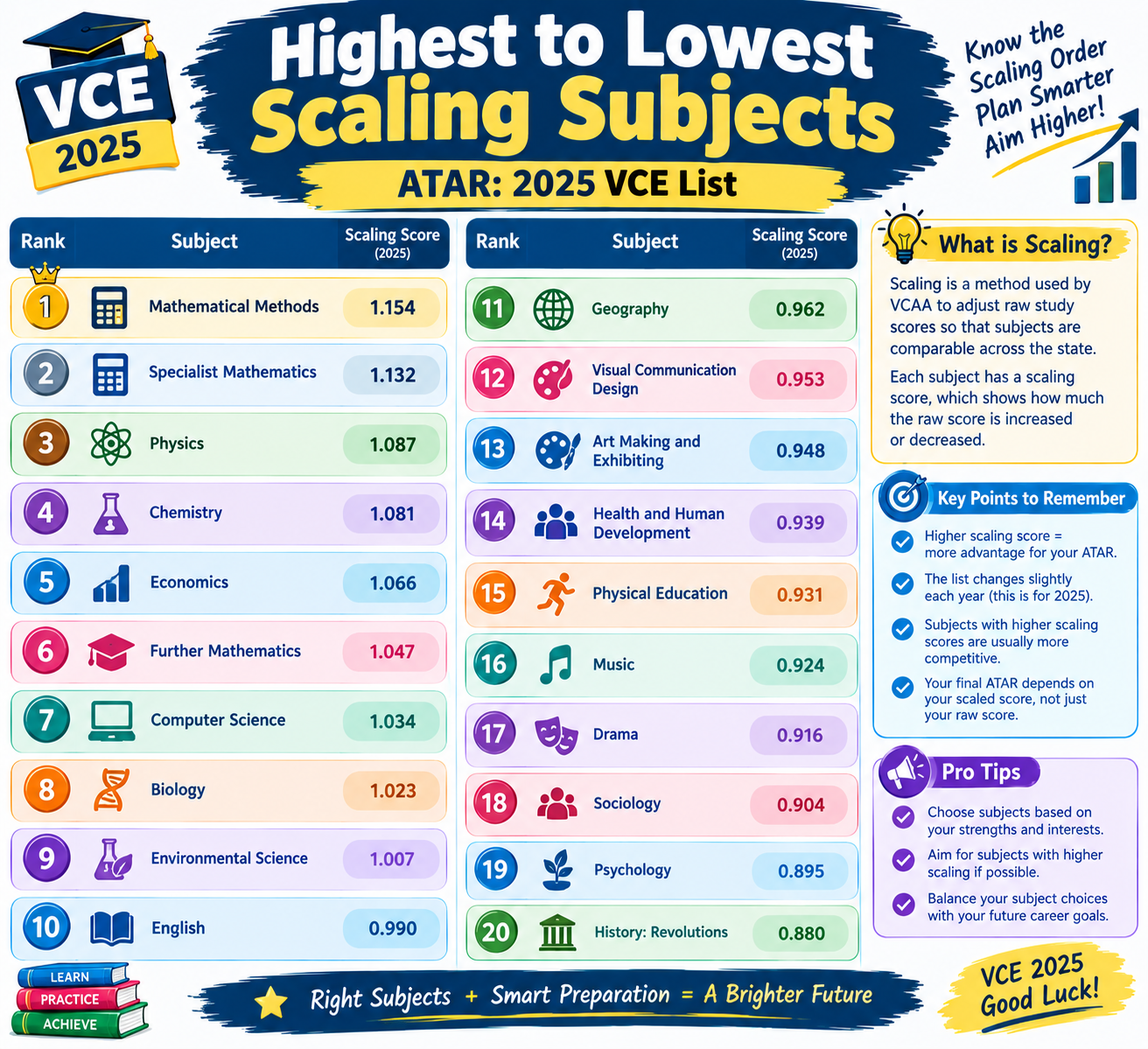
Some subjects tend to scale up more often than others. For example, advanced mathematics and some languages often scale up. On the other hand, some large subjects often scale down a little.
However, there is no fixed list. Scaling depends on the students in each year. A subject that scales up one year may scale less the next year. Therefore, do not trust old lists blindly.
Our next guide, highest to lowest scaling subjects for ATAR, looks at this pattern more closely.
How the Aggregate Is Built
After scaling, VTAC builds your aggregate. The aggregate is the total of your best scaled study scores. It has two parts.
The primary four. These are your best scaled score in the English group, plus your next three best scaled scores. The English group includes English, EAL, Literature, and English Language. One of them is compulsory.
The increments. VTAC adds 10% of your fifth best scaled score and 10% of your sixth best scaled score.
So the formula is simple.
Aggregate = English score + next three best scores + 10% of the fifth + 10% of the sixth
VTAC may allow other rules for special cases. Therefore, check the official page for your situation.
Worked Example of an Aggregate
Let us build an aggregate with made-up numbers. These scaled scores are for learning only.
| Subject | Scaled score | How it counts |
|---|---|---|
| English | 36.0 | Counts in full |
| Mathematical Methods | 40.0 | Counts in full |
| Chemistry | 38.0 | Counts in full |
| Psychology | 35.0 | Counts in full |
| Business Management | 30.0 | 10% counts, so 3.0 |
| Accounting | 28.0 | 10% counts, so 2.8 |
Now add the numbers. The primary four total 36.0 + 40.0 + 38.0 + 35.0, which equals 149.0. Next, add the increments, which are 3.0 and 2.8. The final aggregate is 154.8.
Notice one useful point. The first four subjects do almost all the work. Even a big change in your fifth or sixth subject moves the aggregate only a little.
From Aggregate to ATAR
The last step turns your aggregate into an ATAR. VTAC ranks every student’s aggregate. Then it converts the rank into a percentile.
The ATAR is not a mark out of 100. Instead, it is a ranking. For example, an ATAR of 80 means your result is above about 80 percent of students in your age group. The ATAR runs from 0 to 99.95 in steps of 0.05.
VTAC publishes a table each year that shows which aggregate matches which ATAR. Since the numbers change, you cannot rely on last year’s table.
Common Myths About Subject and Scale VCE
Many students believe ideas that are not true. Let us fix the main ones.
| Myth | Fact |
|---|---|
| “Scaling lowers my study score.” | Your study score stays the same. Only the number used in the ATAR changes. |
| “Hard subjects always scale up.” | Scaling depends on the strength of the students, not on how hard the content is. |
| “My ATAR uses raw scores.” | The ATAR uses scaled scores. |
| “A subject that scaled up last year will do so again.” | Scaling changes every year. |
| “I should only pick subjects that scale up.” | Interest and ability matter more. |
| “My fifth subject does not matter.” | It adds 10%, so it matters a little. |
How to Choose Subjects Wisely
Scaling can feel like a puzzle, but a simple plan works best.
First, choose subjects you enjoy and can do well in. A high study score in a subject you like usually beats a weak score in a subject that scaled up. Second, check the entry rules for the courses you want, because some courses need specific subjects. Third, use scaling only as a small extra clue.
In addition, talk to your teachers and career adviser. They know your strengths and the latest rules. Finally, remember that your ATAR is only one path. Many universities also offer other entry routes.
Quick Revision Table
Read this table before your exam or subject-selection meeting.
| Idea | Key fact |
|---|---|
| Study score | 0 to 50, set by VCAA |
| Typical average | About 30 |
| Scaling | Done by VTAC, based on student strength |
| Scaled score | Used in the aggregate |
| Primary four | English group plus next three best |
| Increments | 10% of fifth and sixth |
| ATAR | A ranking from 0 to 99.95 |
| Scaling Report | Published each December |
Practice Questions on Subject and Scale VCE
Try these 10 questions on your own first. The answers come next.
- Who sets VCE study scores?
- Who scales the study scores?
- What is the range of a study score?
- What is the average study score?
- What does the primary four include?
- How much do the fifth and sixth subjects count?
- Scaled scores: English 34, then 38, 36, 32, fifth 30, sixth 20. What is the aggregate?
- True or false: The ATAR uses raw study scores.
- True or false: Scaling depends on the strength of the students in each subject.
- When does VTAC publish its Scaling Report?
Answers and Short Explanations
- VCAA sets the study scores.
- VTAC does the scaling.
- From 0 to 50.
- About 30.
- The best English group score plus the next three best scaled scores.
- Each counts at 10%.
- The primary four are 34 + 38 + 36 + 32, which equals 140. The increments are 3 and 2. So the aggregate is 145.
- False. The ATAR uses scaled scores.
- True. Scaling compares the strength of each group.
- In December of each year.
If you score 8 or more, you understand the topic well. If you score less, reread the sections on the aggregate and the worked example.
Conclusion: Subject and Scale VCE Made Simple
Subject and scale VCE comes down to a clear chain. VCAA gives you a study score. VTAC scales it based on the strength of the students in the subject. Then VTAC adds your best scaled scores into an aggregate, and ranks it as your ATAR.
Keep four points in mind. First, scaling does not change your study score. Second, it changes every year. Third, the first four subjects count in full, while the fifth and sixth count at 10%. Finally, choose subjects you can do well in, and use scaling only as a small clue.
It is a way to talk about how VCE subjects are scaled. VTAC adjusts each study score so that scores from different subjects can be compared fairly. After that, VTAC builds your aggregate and your ATAR.
VTAC checks how the students in each subject did in their other subjects. If that group was stronger than average, the subject’s scores scale up. If it was weaker, they scale down.
Yes. Scaling depends on the students who take each subject, so the numbers change every year. VTAC publishes the official figures in its December Scaling Report.
No. Your study score stays the same on your results. Scaling only changes the number that goes into your aggregate.
Yes. You need a study from the English group, such as English, EAL, Literature, or English Language. Your best English group score counts in the primary four.
Up to six. Four count in full, and the fifth and sixth count at 10% each.
No. Interest and ability matter more. A strong result in a subject you like is usually better than a weak result in a subject that scaled up.
VCAA runs the VCE and sets study scores. VTAC scales the scores and calculates the ATAR.
Check the VTAC website, where the Scaling Report appears each December. Please use that source rather than old lists.
Other states also scale subjects to build an ATAR, but each state runs its own system. Therefore, use the rules of your own state.


12 thoughts on “Subject and Scale VCE: How Scaling Works Simply”