The subject and agent difference confuses many students. Both words sound like they mean the same thing. In many sentences, they do point to the same person. However, in many other sentences, they do not.
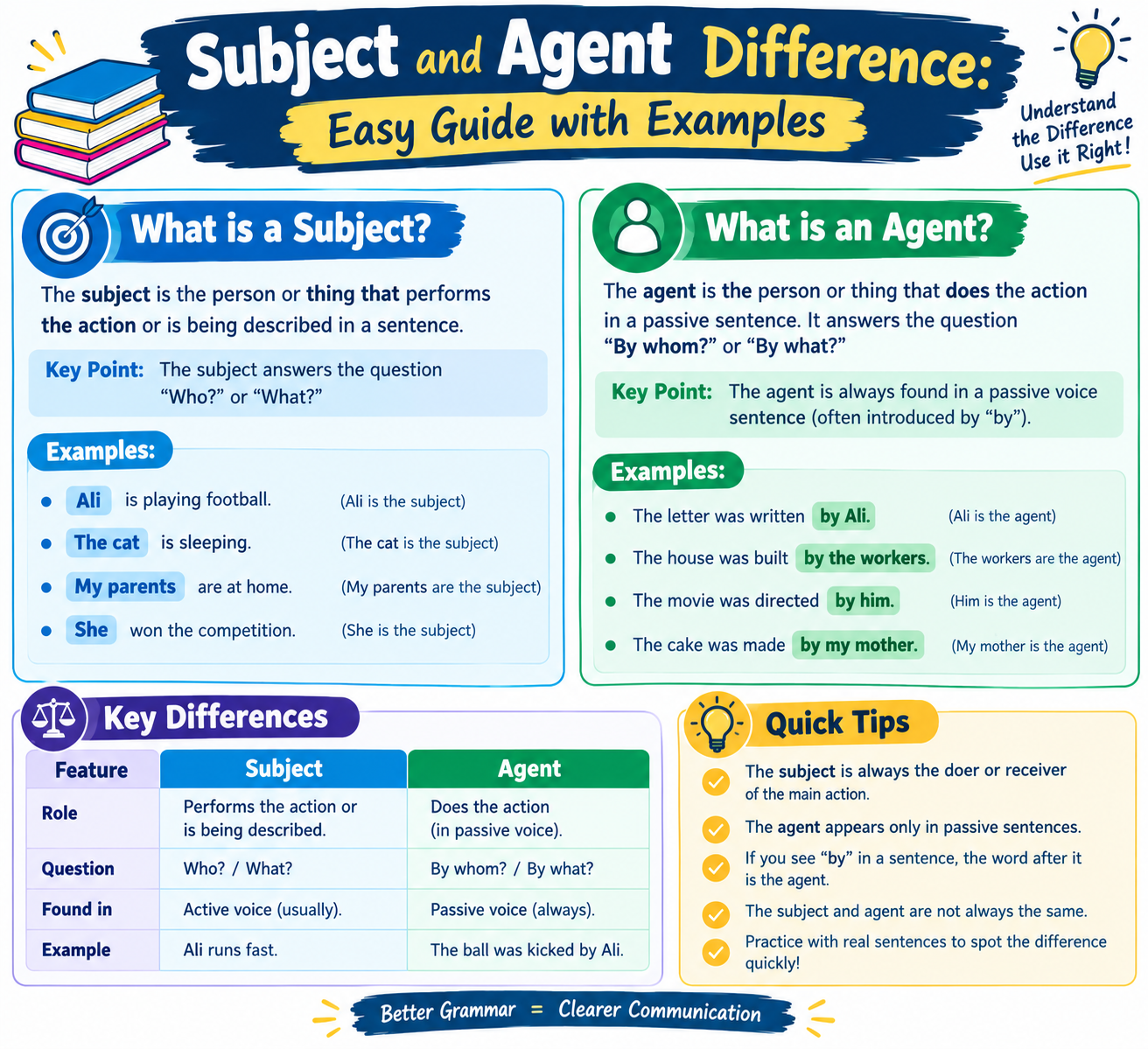
Here is the short answer. The subject is a grammar role. It tells you which word the verb agrees with. The agent is a meaning role. It tells you who or what does the action. Therefore, the subject is about form, and the agent is about meaning.
In this guide, you will learn both ideas step by step. You will see active and passive examples, and you will meet subjects that do not act at all. Finally, you will solve 12 practice questions with answers. We use easy words and short sentences, so you can learn fast.
Subject and Agent Difference in One Minute
Read this table first. It shows the whole idea in a few rows.
| Point | Subject | Agent |
|---|---|---|
| Type | Grammar role | Meaning role |
| Question it answers | Which word does the verb agree with? | Who or what does the action? |
| Usual place | Before the verb | Before the verb, or after the word by |
| Needs an action? | No | Yes |
| Active example | The chef cooked the meal. Subject: the chef | The chef cooked the meal. Agent: the chef |
| Passive example | The meal was cooked by the chef. Subject: the meal | The meal was cooked by the chef. Agent: the chef |
Look at the last two rows. In the active sentence, the subject and the agent are the same word. In the passive sentence, they are different. That small change is the heart of the subject and agent difference.
What Is a Subject?
The subject is the word or group of words that the sentence is about. Also, it is the word that controls the verb. For example, we say “The boy plays” but “The boys play.” The verb changes because the subject changes.
To find the subject, first find the verb. Then ask “Who?” or “What?” before it. In “The tall girl won the race,” the verb is won. Who won? The tall girl. So the subject is the tall girl.
A subject does not have to do anything. For instance, in “The sky is blue,” the sky does no action. Still, it is the subject. Similarly, in “Sara likes tea,” Sara does not perform an action. She only has a feeling.
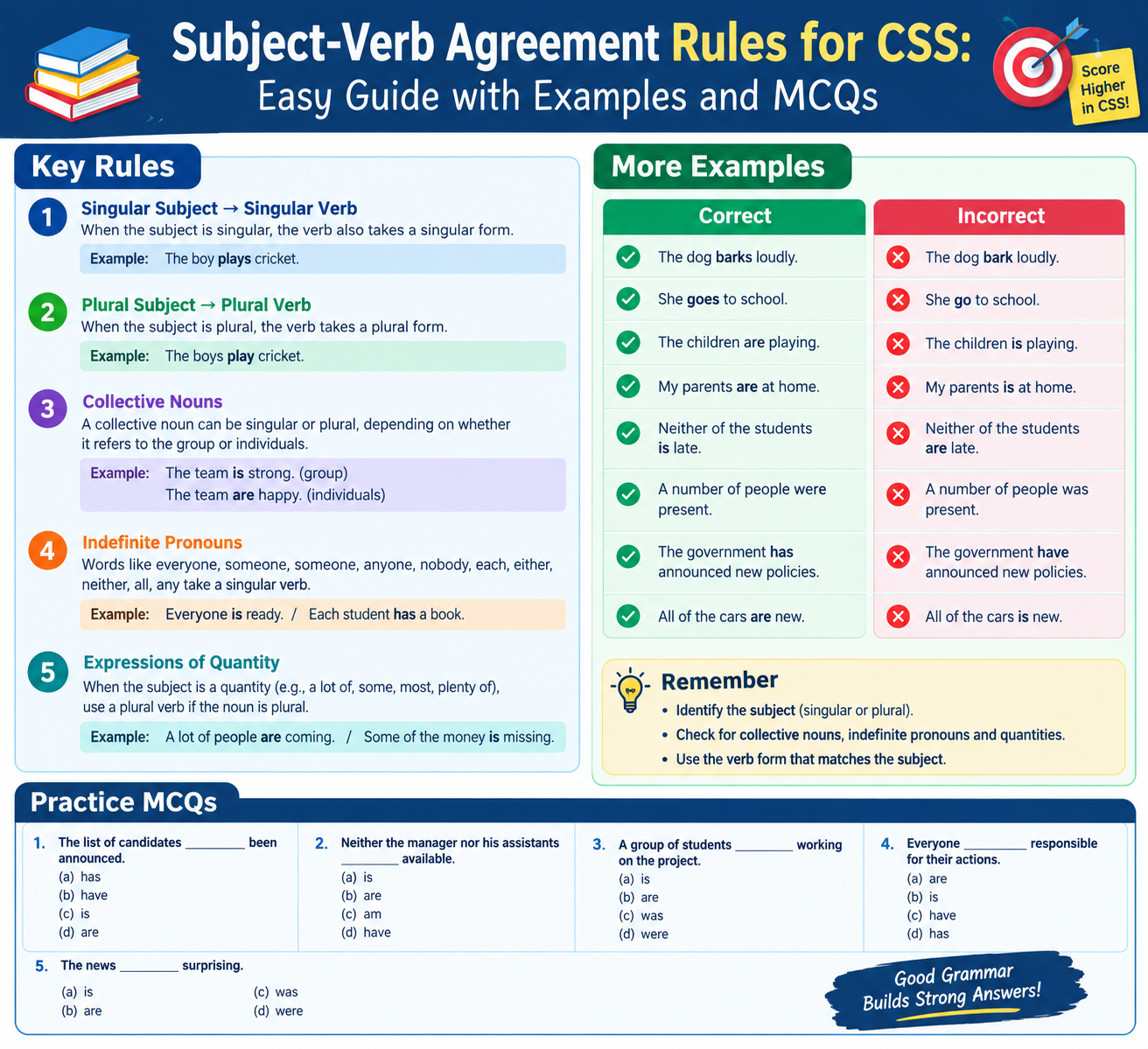
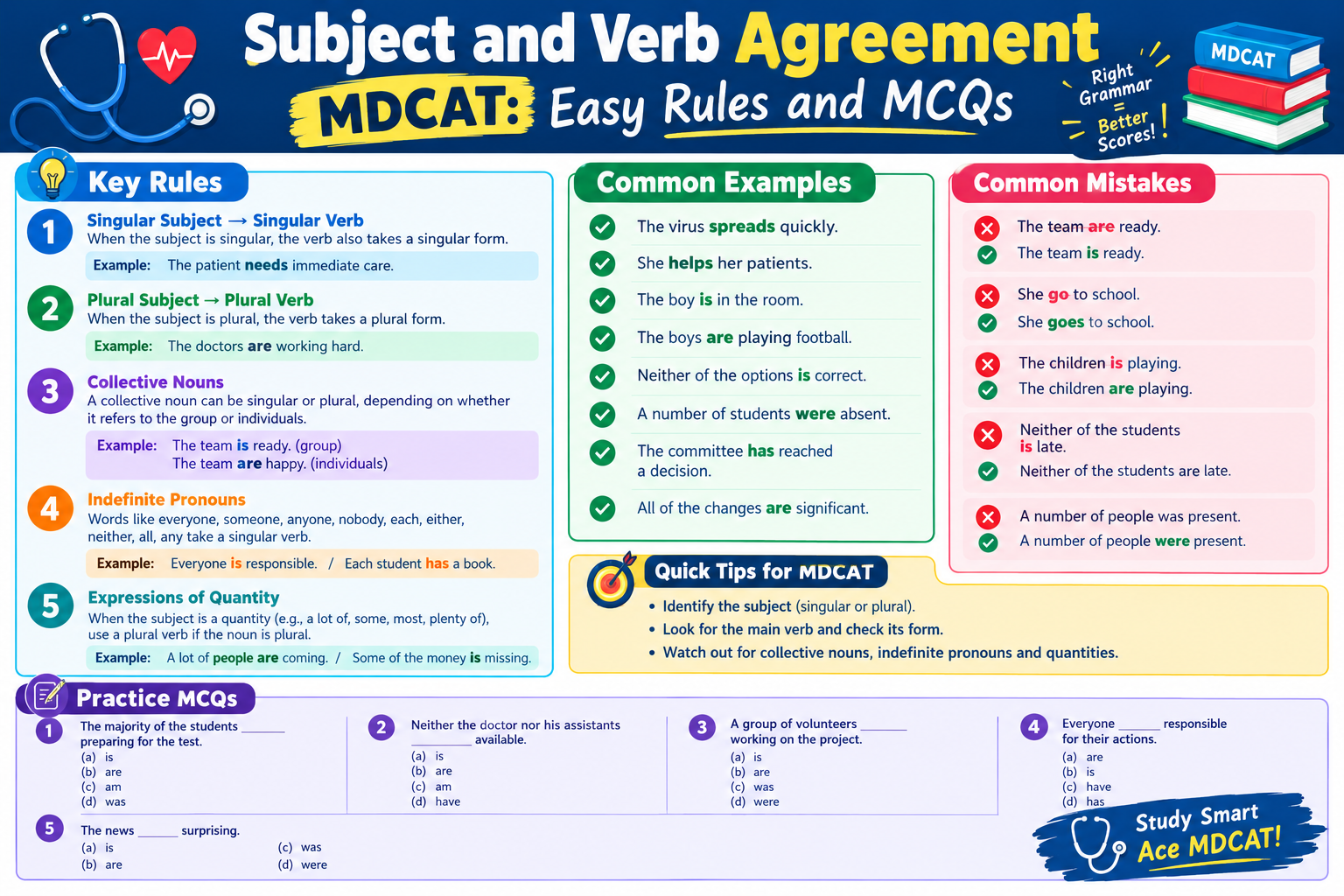
If you need more help, read our guide on subject and object. Our guides on subject-verb agreement for CSS and subject and verb agreement MDCAT also show how the subject controls the verb.
What Is an Agent?
The agent is the person or thing that does an action on purpose. In other words, it is the doer. An agent usually has a will, and it controls what happens. Because of that, most agents are people or animals.
For example, in “The chef cooked the meal,” the chef is the agent. The chef chose to cook and controlled the action. In “The dog chased the cat,” the dog is the agent for the same reason.
Two quick tests will help you find a true agent.
The deliberately test. Add the word deliberately before the verb. If the sentence still makes sense, the word is an agent. For example, “The boy deliberately broke the glass” makes sense. However, “The glass deliberately broke” sounds strange. So the boy is the agent, and the glass is not.
The command test. Turn the sentence into a command. If it works, the doer is an agent. For example, “Break the glass!” makes sense. On the other hand, “Like tea!” sounds odd, because liking is not a deliberate action.
Subject and Agent Difference in Active Sentences
In an active sentence, the subject does the action. As a result, the subject and the agent are the same word. This is the simple case, and most students find it easy.
| Active sentence | Subject | Agent |
|---|---|---|
| Fatima kicked the ball. | Fatima | Fatima |
| The doctors treated the patients. | The doctors | The doctors |
| My brother wrote a letter. | My brother | My brother |
So you can say that active voice is where the subject and the agent meet. However, the picture changes as soon as the sentence turns passive.
Subject and Agent Difference in Passive Sentences
In a passive sentence, the receiver of the action becomes the subject. Meanwhile, the doer moves to the end of the sentence, usually after the word by. This doer is still the agent, but it is no longer the subject.
Let us compare three pairs.
| Active | Passive | Passive subject | Agent |
|---|---|---|---|
| The teacher praised the boy. | The boy was praised by the teacher. | The boy | The teacher |
| Hina wrote the letter. | The letter was written by Hina. | The letter | Hina |
| The nurse called the doctor. | The doctor was called by the nurse. | The doctor | The nurse |
Notice two things. First, the passive subject receives the action, so it is not the agent. Second, the agent appears in a “by” phrase. Some books call this the agent phrase.
The verb also agrees with the new subject. For example, we say “The letter was written” but “The letters were written.” The agent does not control the verb in a passive sentence. If you want to see how this works, our guide on subject and verb agreement MDCAT rules has many examples.
Subject and Agent Difference: Subjects That Do Not Act
The subject is not always a doer. In fact, many subjects do nothing at all. Here are the most common types.
Experiencer subjects. These subjects feel, think, or sense something. For example, “Sara likes tea” and “Ali heard a noise.” Sara and Ali do not do anything on purpose, so they are not agents.
State and place subjects. These subjects only describe a condition. For instance, “The book is on the table” and “The water is cold.” No action takes place here.
Changing subjects. These subjects go through a change, but they do not cause it. For example, “The ice melted” and “The glass broke.” The ice and the glass are subjects, but they are not doers.
Instrument subjects. These subjects are tools. For example, “The key opened the door.” A person used the key, so the real agent is missing from the sentence.
Force subjects. These are natural causes, such as storms and floods. For instance, “The flood damaged the crops.” A flood causes the damage, but it has no will. Many teachers call it a force instead of an agent.
Dummy subjects. These are small words that fill the subject place. Examples are “It is raining” and “There are three books.” Here, it and there do not point to any doer.
Agentless Passives: When the Agent Disappears
Sometimes a passive sentence has no agent at all. Grammar books call this an agentless passive. For example, “The window was broken.” We do not know who broke it, so the sentence leaves the agent out.
Writers drop the agent for several reasons. First, the doer may be unknown, as in “My phone was stolen.” Second, the doer may not matter, as in “The road was repaired last year.” Third, a writer may want to hide the doer, as in “Mistakes were made.”
Science writing uses this style a lot. For example, a lab report may say “The sample was heated for ten minutes.” The reader cares about the sample and the method, not about who held the burner.
When you see an agentless passive, remember the key point. The sentence still has a subject, but it has no stated agent.
How to Find the Agent in 4 Easy Steps
Use these steps on any sentence. We will test them on “The cake was baked by my mother.”
Step 1: Find the verb. The verb is was baked.
Step 2: Find the subject. Ask “What was baked?” The answer is the cake. So the subject is the cake.
Step 3: Ask who or what did the action. Look for a by phrase. Here it says “by my mother,” so my mother is the agent.
Step 4: Check with a test. Try “My mother deliberately baked the cake.” It makes sense, so the answer is right.
Now try a sentence with no doer: “The ice melted.” The subject is the ice. Next, ask who melted it. The sentence does not say. Also, “The ice deliberately melted” sounds odd. Therefore, this sentence has no agent.
Agent vs Object and Agent vs Patient
Students often mix up the agent with other terms. Let us clear this up.
The object is a grammar role. It is the word that receives the verb’s action in an active sentence. For example, in “The dog chased the cat,” the cat is the object. The patient is the matching meaning role. It is the person or thing that receives the action or goes through the change.
So the agent and the patient are opposites. The agent does the action, and the patient receives it. In “The dog chased the cat,” the dog is the agent and the cat is the patient.
The roles stay the same when the sentence turns passive. In “The cat was chased by the dog,” the cat is still the patient, and the dog is still the agent. However, the cat is now the subject, and it is no longer the object. You can see how grammar roles and meaning roles work separately.
Other Meanings of the Word Agent
The word agent has other meanings outside this topic. Knowing them will stop confusion.
First, an agent noun is a noun that names a doer, such as teacher, writer, actor, or driver. These words often end in -er or -or. Second, in law and business, an agent is a person who acts for someone else. Examples are a travel agent and a real estate agent.
These meanings are related, because each one involves a doer. Still, in this article, the agent means the doer of an action in a sentence. For extra reading on related grammar topics, visit the Purdue OWL grammar section.
Common Mistakes in Subject and Agent Difference
Students repeat the same few errors. Fortunately, you can fix each one quickly.
| Common mistake | Why it is wrong | Fix |
|---|---|---|
| “The subject is always the doer.” | In passive sentences, the subject receives the action. | Check the voice first. |
| “The agent is always the subject.” | In passive sentences, the agent follows by. | Look for a by phrase. |
| “Every sentence has an agent.” | Sentences like “The ice melted” have none. | Use the deliberately test. |
| “It in It is raining is the agent.” | It is a dummy subject. | Ask if anything really acts. |
| “The agent is the object.” | The object receives the action. | Remember: agent does, object receives. |
In addition, always check the verb before you decide. The verb agrees with the subject, not with the agent.
Quick Revision Table
Read this table the night before your test. It sums up the subject and agent difference in one place.
| Idea | Subject | Agent |
|---|---|---|
| Role type | Grammar | Meaning |
| Controls the verb? | Yes | No |
| Must act? | No | Yes |
| In active voice | Same as agent | Same as subject |
| In passive voice | The receiver | After by, or missing |
| Can be a thing? | Yes | Rarely |
| Can be missing? | No (except in commands) | Yes |
Practice Questions on Subject and Agent Difference
For each sentence, name the subject. Then name the agent, or write “no agent.” Try them on your own first. The answers come next.
- The teacher praised the boy.
- The boy was praised by the teacher.
- The ice melted.
- Ali heard a noise.
- The report was finished yesterday.
- The storm destroyed the bridge.
- Fatima kicked the ball.
- It is cold today.
- The letter was written by Hina.
- The key opened the lock.
- There is a problem.
- The doctor was called by the nurse.
Answers and Short Explanations
- Subject: the teacher. Agent: the teacher. This is an active sentence.
- Subject: the boy. Agent: the teacher. The agent follows by.
- Subject: the ice. No agent, because the ice only changes.
- Subject: Ali. No agent, because hearing is not a deliberate action.
- Subject: the report. No agent, because the sentence does not name the doer.
- Subject: the storm. The storm is a force, so many teachers say it has no true agent.
- Subject: Fatima. Agent: Fatima.
- Subject: it. No agent, because it is a dummy subject.
- Subject: the letter. Agent: Hina.
- Subject: the key. The key is an instrument, and the person who used it is missing.
- Subject: a problem (with there as a dummy word). No agent.
- Subject: the doctor. Agent: the nurse.
If you score 10 or more, you understand the topic well. If you score less, reread the sections on passive sentences and subjects that do not act.
FAQs on Subject and Agent Difference
What is the subject and agent difference in simple words?
The subject is the grammar role that controls the verb. The agent is the meaning role of the one who does the action. In active sentences they are the same, but in passive sentences they are different.
Is the subject always the agent?
No. In passive sentences, the subject receives the action. Also, many subjects only feel, exist, or change, as in “Sara likes tea” and “The ice melted.”
Where does the agent go in a passive sentence?
The agent usually goes after the word by, near the end of the sentence. For example, “The song was sung by Ali.” Sometimes the writer leaves it out.
What is an agentless passive?
It is a passive sentence with no stated doer, such as “The window was broken.” Writers use it when the doer is unknown, unimportant, or hidden.
Does the subject and agent difference matter in exams?
Yes. Questions on active and passive voice, sentence correction, and error spotting rely on this idea. If you can separate the two roles, you can change voice without mistakes.
How do I find the agent quickly?
First find the verb. Next, ask who or what did the action on purpose. Then use the deliberately test. If the sentence still makes sense, you have found the agent.
Can the agent be a thing?
Sometimes. A tool or a natural force can look like an agent, as in “The wind opened the door.” Still, strict grammar says a true agent acts on purpose, so it is usually a person or an animal.
What is an agent noun?
An agent noun names a doer. Examples are teacher, writer, driver, and actor. Many end in -er or -or.
What is the difference between an agent and an object?
The agent does the action, and the object receives it. In “The dog chased the cat,” the dog is the agent and the cat is the object.
What is the best way to learn the subject and agent difference?
Practice with pairs of active and passive sentences. Mark the subject and the agent in each one. After a few days, the difference will feel natural.
Conclusion: Subject and Agent Difference Made Simple
The subject and agent difference comes down to one idea. The subject is a grammar role, and the agent is a meaning role. In active sentences, one word plays both roles. In passive sentences, the roles split apart.
Keep these points in mind. First, the subject controls the verb, but it does not always act. Second, the agent does the action on purpose, and it may follow by or disappear. Third, experiencers, states, changes, tools, forces, and dummy words can all be subjects without being agents.
Practice with your own sentences every day, and the difference will become clear. Next, try changing five active sentences into passive ones. Then mark the subject and agent in each.