
The word subject has many meanings, and that is why students search for the subject in detail. Sometimes it means a part of a sentence. Sometimes it means a school course, such as physics. At other times it means the topic of a talk or the line of an email.
In this guide, we explain the subject in detail, step by step. First, you will learn the types of subject in grammar. Next, you will see how a subject area differs from a subject in school and college. Then you will meet the other meanings of the word. Finally, you will solve 12 practice questions with answers.
We use easy words and short sentences, so you can read quickly and remember more. Let us begin.
Subject in Detail: Meanings at a Glance
Before we go deeper, look at this table. It shows the main meanings of the word subject, each with a short example.
| Meaning | Short explanation | Example |
|---|---|---|
| Grammar subject | The part of a sentence that the verb agrees with | The dog barked. |
| Topic or theme | What a talk, book, or essay is about | The subject of the essay is climate change. |
| School subject | A course of study | Chemistry is my favorite subject. |
| Subject area | A wide field that holds many subjects | Physics belongs to natural science. |
| Email subject line | The short title at the top of an email | Write a clear subject line. |
| Research subject | A person who takes part in a study | The subjects in the study were adults. |
| Political subject | A person under a ruler | He was a subject of the king. |
| Being subject to | Likely to be affected by something | Prices are subject to change. |
As you can see, context decides the meaning. In the next sections, we explain the two most searched meanings first, which are the grammar subject and the subject area.
What Is a Subject in Grammar?
In grammar, the subject is the part of a sentence that the sentence is about. It also controls the verb. For example, we say “The boy plays” but “The boys play.” The verb changes because the subject changes.
To find the subject, first find the verb. Then ask “Who?” or “What?” before the verb. In “The tall girl won the race,” the verb is won. Who won? The tall girl. So the subject is the tall girl.
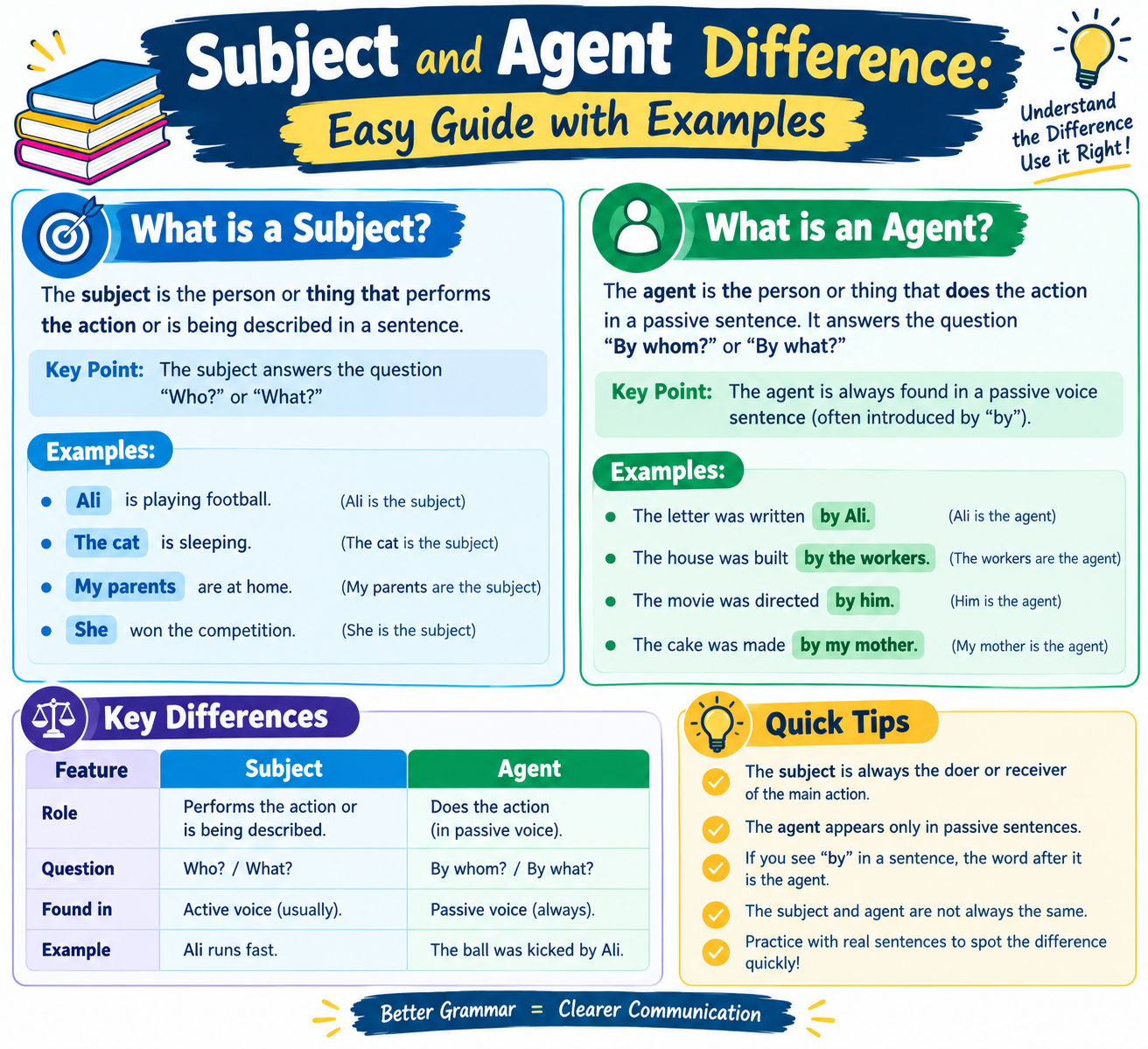
If you want a full lesson on how the subject differs from the object, read our guide on subject and object. Also, our article on the subject and agent difference shows why the subject does not always do the action.
Subject in Detail: Simple, Complete, and Compound Subjects
Grammar books sort subjects into three common types. Learn these first, because they appear in almost every exam.
Simple subject. The simple subject is the main noun or pronoun, with no extra words. For example, in “Birds fly,” the simple subject is birds. Likewise, in “The old teacher smiled,” the simple subject is teacher.
Complete subject. The complete subject is the simple subject plus all the words that describe it. For example, in “The old teacher in the blue coat smiled,” the complete subject is the old teacher in the blue coat. The simple subject is still teacher.
Compound subject. A compound subject has two or more subjects joined by and or or. For example, “Ali and Hamza play cricket” has two subjects. In the same way, “Tea or coffee is fine” has two choices.
A quick trick helps you tell them apart. Cut the complete subject down to one key word, and you get the simple subject. If two key words remain, the subject is compound.
Subject in Detail: What Can Fill the Subject Place?
Many students think a subject must be one noun. In fact, several kinds of words and phrases can act as a subject. Here is the full list.
A noun. For example, “Teachers work hard.”
A pronoun. For example, “She works hard.” Subject pronouns are I, you, he, she, it, we, they, and who.
A noun phrase. For example, “The new teacher works hard.”
A gerund. A gerund is a verb with -ing that acts like a noun. For example, “Reading improves vocabulary.”
An infinitive. An infinitive is to plus a verb. For example, “To win requires effort.”
A noun clause. A noun clause is a group of words with its own verb. For example, “What she said surprised everyone.”
In each case, the verb stays singular when the subject is a gerund, an infinitive, or a clause. Therefore, we write “Reading improves” and not “Reading improve.”
Hidden, Dummy, and Inverted Subjects
Some subjects are harder to spot. They hide, they fill a space, or they move away from their usual place. Learn these three, and you will stop making mistakes.
Hidden subject. In a command, the subject you is understood but not written. For example, “Close the door” means “You close the door.”
Dummy subject. A dummy subject is a small word that fills the subject place without any real meaning. The words it and there do this job. For example, “It is raining” and “There are three books on the desk.” In the second sentence, the real subject is three books.
Delayed subject. Sometimes the real subject comes late. For example, in “It is easy to learn grammar,” the real subject is to learn grammar. The word it only holds the place.
Inverted subject. In questions and formal writing, the subject can come after the verb. For example, “Where are the keys?” has the subject keys. Also, “Never have I seen such a view” has the subject I.
Subject by Number and Person
Another way to sort subjects is by number and person. This idea matters because the verb must match it.
Number tells you if the subject is singular (one) or plural (more than one). Person tells you who is speaking or spoken about.
| Person | Singular | Plural |
|---|---|---|
| First (speaker) | I | we |
| Second (listener) | you | you |
| Third (someone else) | he, she, it | they |
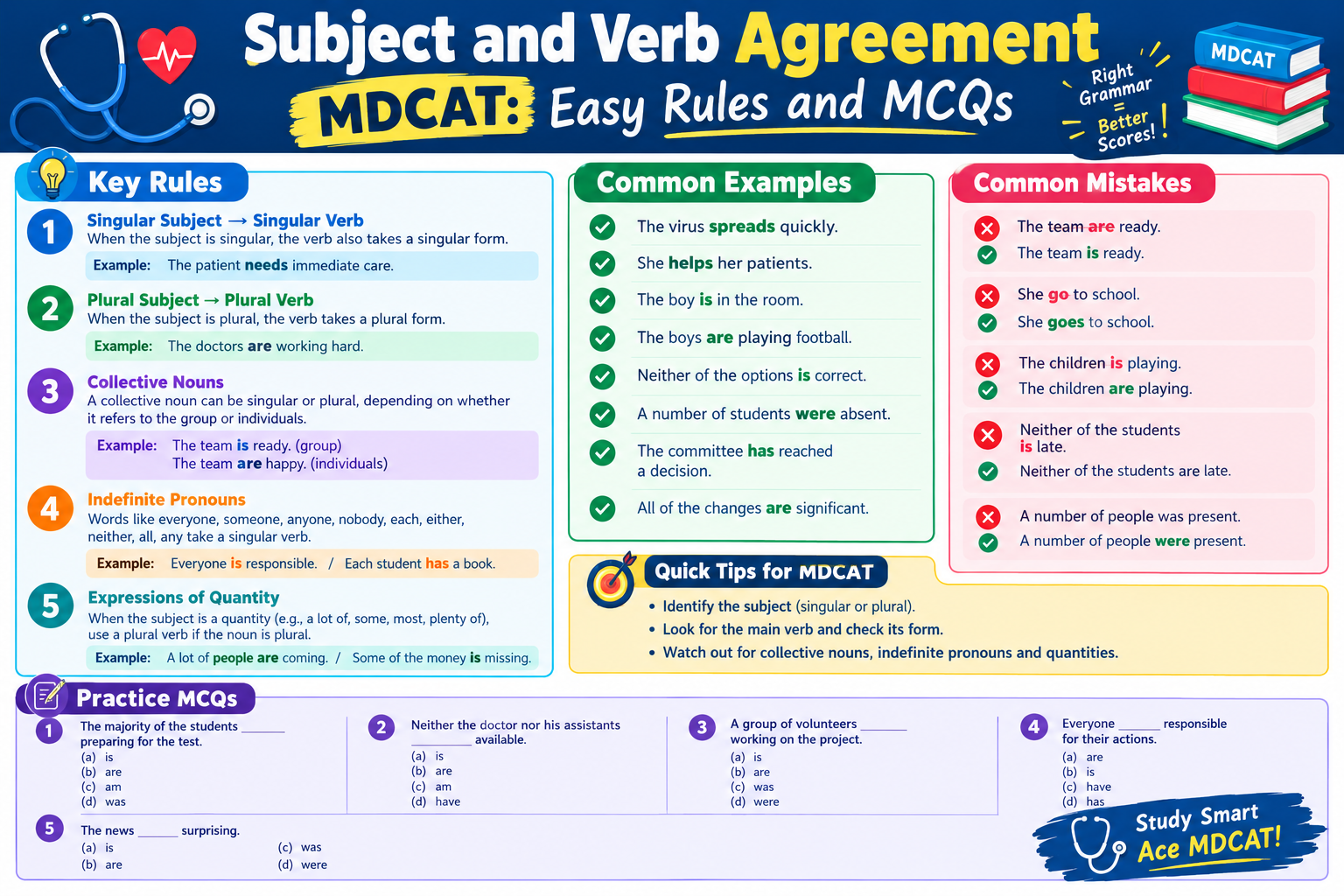
For example, we say “I am,” “she is,” and “they are.” If you want to master this link between the subject and the verb, read our guides on subject-verb agreement for CSS and subject and verb agreement MDCAT.
Subject in Detail: What Is a School Subject?
Now let us move from grammar to education. A school subject is a course of study, such as mathematics, English, physics, chemistry, biology, history, or computer science.
Schools and colleges usually split subjects into two groups.
Core or compulsory subjects. Every student must study these. For example, language and mathematics are often compulsory.
Elective or optional subjects. Students choose these based on their interest or career plan. For instance, a student may choose biology or computer science.
In many education systems, students pick a group of subjects, such as pre-medical or pre-engineering. As a result, the subjects you choose can shape your later study options. Therefore, it is wise to choose with care.
Subject Area: How It Differs from a Subject
A subject area is a wide field that holds many related subjects. In simple words, a subject is one course, and a subject area is the larger family that the course belongs to.
For example, physics, chemistry, and biology are three subjects. Together, they belong to the subject area of natural science. Similarly, history, literature, and philosophy sit in the subject area of humanities.
Here is a table of common subject areas.
| Subject area | Example subjects |
|---|---|
| Natural science | Physics, chemistry, biology, earth science |
| Mathematics and computing | Algebra, statistics, computer science |
| Social science | Economics, psychology, sociology, political science |
| Humanities | History, literature, philosophy, religion |
| Languages | English, Urdu, Arabic, French |
| Business and management | Accounting, marketing, finance |
| Health and medicine | Anatomy, nursing, public health |
| Engineering and technology | Civil, electrical, mechanical engineering |
So when a university form asks for your subject area, it wants the broad field. When it asks for your subject, it wants the specific course or major.
Subject Area in Research and Libraries
The idea of a subject area also helps in research. Libraries, journals, and databases group their items by subject area. As a result, you can find what you need faster.
Here are three ways to use subject areas well.
First, pick a broad subject area for your topic, and then narrow it down. For example, start with health and medicine, then move to public health, and then to a single disease.
Second, use subject headings in a library catalog. Headings are fixed labels that the library gives to books. In contrast, keywords are free words that you choose yourself. Using both gives better results.
Third, look at the subject area of a journal before you cite it. A journal on education may not suit a paper on physics. This simple check protects the quality of your work.
Subject, Topic, Theme, and Subject Line
Students often mix the words subject, topic, and theme. Although they are close, each has its own shade.
The subject is the broad thing a text deals with. For example, the subject of a book may be war. The topic is a narrower point inside it, such as the effects of war on children. The theme is the deeper message, such as the cost of violence.
An email subject line is different again. It is the short title that tells the reader why you wrote. A good subject line is clear, short, and specific. For example, “Meeting moved to Friday at 10 a.m.” works better than “Hello.”
Other Meanings of Subject
Finally, the word subject has a few more uses that you should know.
In logic and philosophy, the subject is the thing a statement is about. For example, in “All humans are mortal,” the subject is humans. The predicate is the part that says something about it.
In science and psychology, a subject is a person or animal that takes part in an experiment. Today, many writers prefer the word participant for people.
In politics, a subject is a person under the rule of a king or queen. For example, “She was a subject of the queen.”
The phrase subject to is also common. It means likely to be affected by something. For example, “Prices are subject to change.” In this case, subject works as an adjective. Likewise, the verb to subject means to make someone go through something, as in “The test subjected the students to stress.” For extra reading, visit the Purdue OWL grammar section.
How to Choose the Right Subject Area
If you are a student, you may need to pick a subject area for college. These simple tips can help.
First, list the subjects you enjoy and do well in. Second, think about the careers that match them. Then check the entry rules for each course, because some courses ask for specific subjects. Also, talk to teachers and to people who work in the field.
Moreover, remember that some education systems use subject scaling. This means the marks of some subjects count for more than others when ranks are made. We explain how it works in a later guide on this site.
Common Mistakes with the Word Subject
Students repeat the same few errors. Fortunately, you can fix each one fast.
| Common mistake | Why it is wrong | Fix |
|---|---|---|
| “The subject is always the first word.” | In many sentences, other words come first. | Find the verb, then ask who or what. |
| “The subject is the nearest noun to the verb.” | Extra phrases can sit between them. | Ignore words after of, in, with. |
| “Every sentence shows its subject.” | Commands hide the subject. | Add you in your mind. |
| “It in It is raining means something.” | It is a dummy subject. | Look for a real subject. |
| “Subject and subject area are the same.” | A subject area is wider. | Think course versus field. |
| “Subject, topic, and theme mean the same.” | Each has a different size. | Think wide, narrow, deep. |
In addition, always check the meaning from the context. The same word can mean a grammar part in one sentence and a school course in another.
Quick Revision Table
Read this table the night before your exam. It sums up the subject in detail in a few lines.
| Idea | Key point | Example |
|---|---|---|
| Simple subject | Main noun or pronoun | Birds fly. |
| Complete subject | Simple subject plus describing words | The old teacher in the blue coat smiled. |
| Compound subject | Two or more subjects | Ali and Hamza play cricket. |
| Hidden subject | You is understood | Close the door. |
| Dummy subject | It or there fills the place | It is raining. |
| Delayed subject | Real subject comes late | It is easy to learn grammar. |
| Inverted subject | Subject follows verb | Where are the keys? |
| School subject | One course | Chemistry |
| Subject area | Wide field | Natural science |
Practice Questions on Subject in Detail
Try these questions on your own first. The answers come next.
- Birds fly. Name the type of subject.
- The tall boy in the red shirt won the prize. What is the complete subject? What is the simple subject?
- Ali and Hamza play cricket. What type of subject is this?
- Close the door. What is the hidden subject?
- It is raining. What type of subject is it?
- Reading improves vocabulary. What form is the subject?
- What she said surprised everyone. What form is the subject?
- Never have I seen such a view. What is the subject?
- In “The subject of the talk is health,” which meaning of subject is used?
- Name the subject area for history, literature, and philosophy.
- In “Prices are subject to change,” what part of speech is subject?
- In “It is easy to learn grammar,” what is the real subject?
Answers and Short Explanations
- Simple subject. The subject is birds.
- Complete subject: the tall boy in the red shirt. Simple subject: boy.
- Compound subject, because two names join with and.
- You. The subject is understood in a command.
- Dummy subject, because it has no real meaning here.
- A gerund, which is a verb with -ing used as a noun.
- A noun clause, because it has its own verb.
- I. The subject comes after the helping verb in this inverted sentence.
- Topic or theme, which means what the talk is about.
- Humanities.
- An adjective, because it is part of the phrase subject to.
- To learn grammar. The word it only holds the place.
If you score 10 or more, you understand the topic well. If you score less, reread the sections on hidden, dummy, and inverted subjects.
Conclusion: Subject in Detail Made Simple
We have now seen the subject in detail from every angle. In grammar, the subject is the part of the sentence that controls the verb, and it comes in simple, complete, compound, hidden, dummy, delayed, and inverted forms. In education, a subject is one course, and a subject area is the wider field that holds many courses.
Keep these points in mind. First, always find the verb before you look for the subject. Second, remember that gerunds, infinitives, and clauses can all be subjects. Third, use context to decide which meaning of subject the writer has in mind.
It means a full look at all the meanings of the word subject. The main ones are the grammar subject, the school subject, the subject area, the topic of a text, and the subject line of an email.
The common types are simple, complete, and compound subjects. In addition, grammar also has hidden, dummy, delayed, and inverted subjects.
A simple subject is only the main noun or pronoun. A complete subject includes all the words that describe it. For example, in “The old teacher smiled,” the simple subject is teacher, and the complete subject is the old teacher.
A subject area is a wide field of study that holds many related subjects. For example, natural science is a subject area, and physics is a subject inside it.
A subject is one course, such as chemistry. A subject area is the larger group, such as natural science. So a subject area contains many subjects.
A full sentence always has a subject. However, in commands the subject you is hidden. For example, “Sit down” means “You sit down.”
A dummy subject is a small word, usually it or there, that fills the subject place. For example, “It is cold.” The word it does not point to any real thing.
Yes. For example, “Swimming is healthy” and “To err is human.” In both cases, the verb is singular.
Study one type at a time, and write two examples for each. Then solve practice questions and mark the subject in every sentence you read. After a week, you will find subjects quickly.
The subject is the wide thing a text covers. The topic is a narrower point inside it. The theme is the deeper message behind it.

7 thoughts on “Subject in Detail: Types of Subject and Subject Area”